
homeostatic
 2
7.7

- adjective
- /ˌhoʊmiəˈstætɪk/
- Specialized
- It's called a homeostatic property cluster.
- homeostatic mechanisms
- homeostatic balance
- homeostatic system
Loading YouTube…
Watch on YouTubeIt's called a homeostatic property cluster.
- It's called a homeostatic property cluster.
- So on mindset, it is shifting from a homeostatic approach to change to an allostatic approach to change.
- That's that emotional cognitive dissonance of where our nervous system wants to just keep things homeostatic, keep things in a familiar pathway.
- And so here they're actually two different They're described as homeostatic hunger and hedonic hunger.
- We had like your whole life would feel more or less homeostatic.
- World of machines, artificial constructs, computers, electronic systems, interlocking homeostatic components.
- The systems we think of as, you know, homeostatic automatic mechanisms like fighting off a virus, like repairing a wound.
Examples
-
Homeostatic regulation of colony environments includes even the most primitive social bees, wasps, and ants.
Academic text (2008) -
I think it's our body's sort of homeostatic mechanism.
-
So what is, what do we mean by a homeostatic mechanism?
-
Aging results in declining homeostatic efficiency.
Academic text (2012) -
So in fact, like these other functions, blood clotting is built upon a homeostatic mechanism.
-
In medical terms, culture is homeostatic (Litwenko and Cooper 1994; Neuhauser 1999).
Academic text (2003) -
It's got these automatic mechanisms, reflexes which which respond to homeostatic deviations and maintain you in your viable bounds.
-
Hypoxic challenges induce physiological homeostatic responses that reduce the mismatch between oxygen supply and tissue demand.
Academic text (2018) -
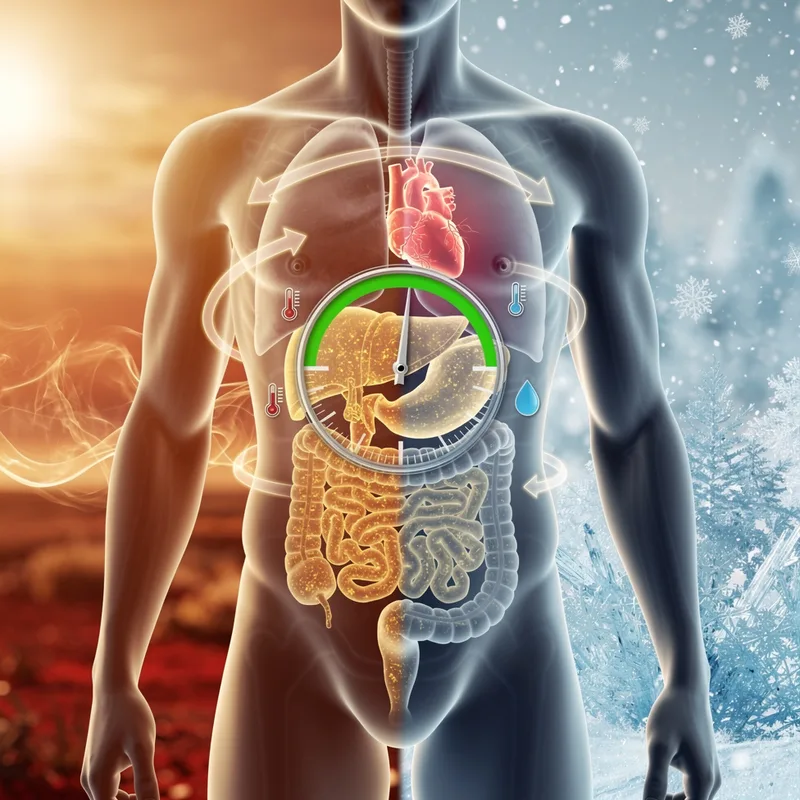
The body uses homeostatic mechanisms to regulate temperature and maintain stability.
-
Processes that keep an organism's internal environment consistent are known as homeostatic mechanisms.
How Stable

Surface Forms
Morphology
homeostatic = homeostasis (transparent) = homeo + stasis + ic
Formed by adding the adjectival suffix '-ic' to the noun 'homeostasis', so the meaning 'relating to homeostasis' is directly derived.
Etymology
The word homeostatic comes from Greek parts homeo- and -stasis, where homeo- means 'same' and -stasis means 'standing still', and you can think of static as 'not moving'. So, homeostatic describes a system that keeps the inside of the body 'stable' or 'the same', like how your body keeps temperature steady.