
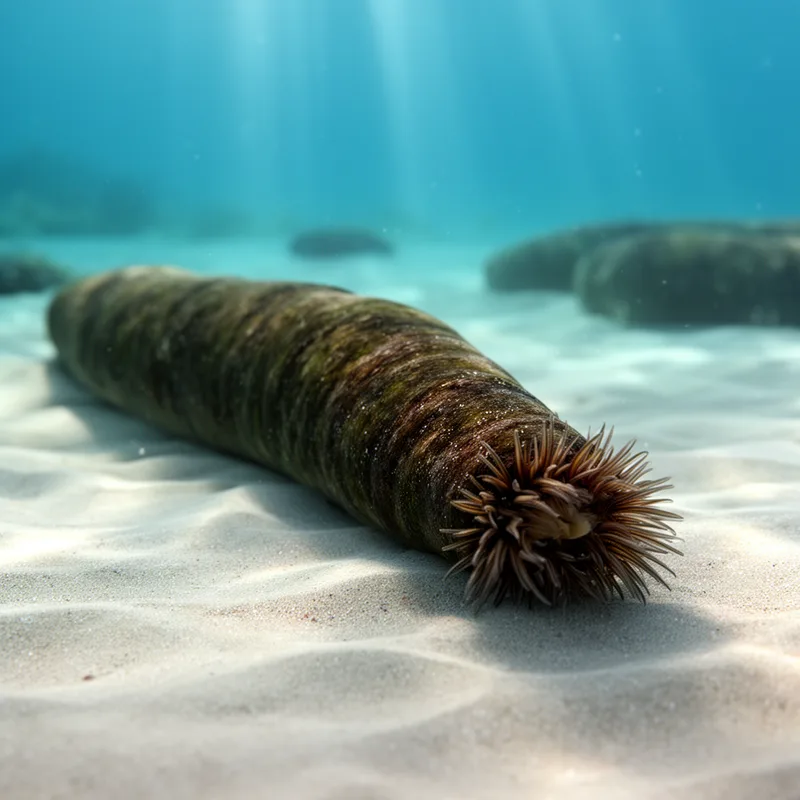
holothurian
- noun
- /ˌhoʊləˈθʊəriən/
- Specialized
- This resulted in a rapid change in the holothurian species being exploited, from first-category species (i.e., H. nobilis and H. fuscogilva) to a second-category species, A. miliaris.
Examples
-
In this review, recent trends in the world holothurian fisheries are analyzed for 1986-90.
Academic text (1993) -
Tropical fisheries are traditionally based on several holothurians (Fig. 1).
Academic text (1993) -
Access to the statistics at the various levels shown in Figure 3 and their reliability is considered in order to present some conclusions and recommendations for further assessment and management of holothurian resources.
Academic text (1993) -
Holothurian catches are often bought by processors who also export beche-de-mer.
Academic text (1993) -
From the 1990 statistics, Japanese imports of holothurians are low, with frozen products at 115 t and dried products at 18 t.
Academic text (1993) -
During the different stages of the processing (boiling, gutting, drying), the length and weight of the holothurians are greatly reduced, resulting in the final product weighing about 10% of the original weight and measuring 50% or less of the original length.
Academic text (1993) -
Information on recruitment, growth, and mortality of holothurians is only available for a few species (Shelley, 1985; Conand, 1989b), and research on these subjects should be given priority.
Academic text (1993) -
The holothurian, commonly known as a sea cucumber, is often found on the ocean floor.
-
Many fishermen target holothurians for their value in the seafood market.
-
Holothurians use their tube feet to move along the ocean floor, feeding on organic matter.
Synonyms

 4
4.8
4
4.8

A soft sea animal with a long body, leathery skin, and tentacles around its mouth
Surface Forms
Etymology
The word holothurian comes from an old Greek name, holothourion, used for the 'sea cucumber'. So a holothurian is the marine animal we now call a 'sea cucumber', named for its soft, cucumber-like body.