

hoary alison
- noun
- Specialized
 :
aliso lanoso
:
aliso lanoso
- The field was overrun with hoary alison, its white blossoms bright against the dull green leaves.
Examples
-
Gardeners often struggle to remove hoary alison when it invades their flowerbeds.
-
Hoary alison is valued by some for its beauty but disliked by others for being a persistent weed.
-
The hoary alison blooms beautifully in the summer.
-
Many gardeners consider hoary alison a nuisance plant.
-
Gardeners often struggle to remove hoary alison when it invades their flowerbeds.
-
The field was overrun with hoary alison, its white blossoms bright against the dull green leaves.
-
Hoary alison is valued by some for its beauty but disliked by others for being a persistent weed.
Synonyms
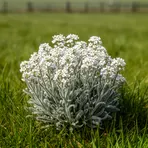
A small European plant with grey green fuzzy leaves, many small white flowers, often a weed

A tall plant with grey-green fuzzy leaves and small white flowers often found as a weed
Surface Forms
Morphology
hoary + alison
The adjective 'hoary' clearly describes a grey-green, downy surface, so a learner who knows that word will infer the MWE refers to a plant with hoary (hairy/whitish) leaves. However, 'alison' is a lexicalized plant name (not a transparent common noun) so the full referent and specific botanical sense cannot be derived from the parts alone. This yields a partially predictable meaning (appearance) but not complete compositional transparency.
Etymology
Hoary alison may come from the plant's look: hoary means 'grey' or 'frost-like' because the leaves have soft hairs, and alison was an old name for small white-flowered plants. So the name paints a clear picture — a tall plant with grey-green, hairy leaves and little white flowers, which is why it refers to this plant today.

