

hitching post
 2
6.2
2
6.2

- noun
- Archaic
- When he reached the sheriff's office at the far end of town, Franklin swung down from his dappled grey horse and took a wrap of the hitching post with one of the leather reins.
- tie a horse to the hitching post
Examples
-
They have also found, throughout the dig sites, broken tools, parts of carriages, and what appears to be a hitching post.
Academic text (2006) -
Beyond the hitching post, a dirt road ran past the fenced pastures and out into the open range.
Fiction book (1991) -
The hitching post is gone.
-
I knew the exact location of the hitching post on the other side of the wall.
-
At the curb were a mounting block and hitching post.
Fiction book (1999) -
At the hitching post, my horse Mouse was sleeping upright in the noon sun.
Fiction book (1991) -
I tied Cheyenne to the hitching post and walked around to the back patio.
Fiction book (1999) -
Ian tethered the horse to a rusted hitching post, resettled his hat, and crossed the yard to stand facing her.
Fiction book (1994) -
Mr. Archy refused to look in their direction, climbed down from the buckboard, and quietly tied the mare to the hitching post.
Fiction book (1996) -
I tied my horse to the hitching post while I grabbed a drink.
Synonyms

A fixed post or rail where people tie horses so they do not wander away
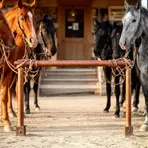
A fixed horizontal bar that people tie horses to so they do not wander
How Large

Surface Forms
Morphology
The meaning 'a post for tying a horse' is directly and transparently derived from combining 'hitch' (to fasten/tie) with 'post' (an upright stake). This is a straightforward purpose-denoting compound/phrase that follows common English composition patterns and is cross-linguistically plausible, so a B1 learner who knows both constituents would readily understand it.
Etymology
The noun hitching post comes from old towns and farms where a hitch meant 'to tie' and a post was a strong wooden pole. People would tie their horse to the post while they went into a shop, so the phrase means a post used to keep a horse from wandering.