
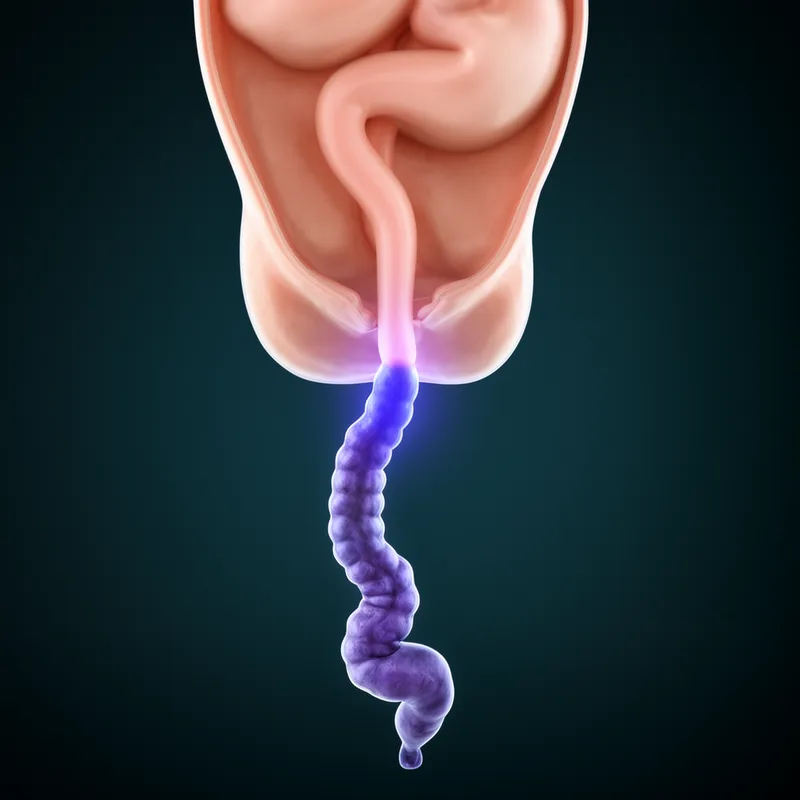
hindgut


 1
9.3
- noun
- /ˈhaɪndˌɡʌt/
- Specialized
- The hindgut of an embryo develops into important structures like the colon and rectum during its growth.
- hindgut fermentation
- core hindgut
Examples
-
Some herbivores, such as horses, carry their fermentation chamber in their hindgut, while others, such as deer and kangaroos, ferment their meals in their foregut, a more complex and specialized process than hindgut fermentation.
Academic text (1992) -
The Tbx20 orthologue, mab-9, is required for the development of the Caenorhabditis elegans hindgut, whereas several vertebrate Tbx20 genes promote heart development.
Blog text (10) -
Anyway, Opalino, which lives in the hindgut of a frog, Marvelous.
-
We found that most of the bees' hindguts contained feces before the flights, but that the majority returned empty.
Academic text (1990) -
Most of the remaining bacteria were killed in the hindgut, indicating that the feces were either sterile or contained only small numbers of bacteria.
Blog text (8) -
In worker hindguts, fermentation products of gut bacteria are produced according to microbiota structure 25.
Academic text (2018) -
However, B. asteroides increases significantly in the hindguts of aging queens independent of pollen consumption.
Academic text (2018) -
In the embryo, the light organ, whose only purpose will be to house bacteria, arises ten days into development in the portion of the mesoderm that includes the hindgut and ink sac.
Academic text (1993) -
One to three major core hindgut bacteria are significantly depleted in six of seven studies, while the studies were more variable concerning shifts of S. alvi and G. apicola, the species pair that dominates the worker ileum.
Academic text (2018) -
Lactobacillus firm5 is the most plentiful bacteria in the queen hindgut, and combined with increased B. asteroides, may add to the butyrogenic effect in queens concurrent with increased biological age.
Academic text (2018)
Surface Forms
Morphology
Etymology
The word hindgut is made of hind ('back' or 'rear') and gut ('intestine'). So the hindgut is the back part of the intestine in an embryo that later becomes the colon and rectum.