
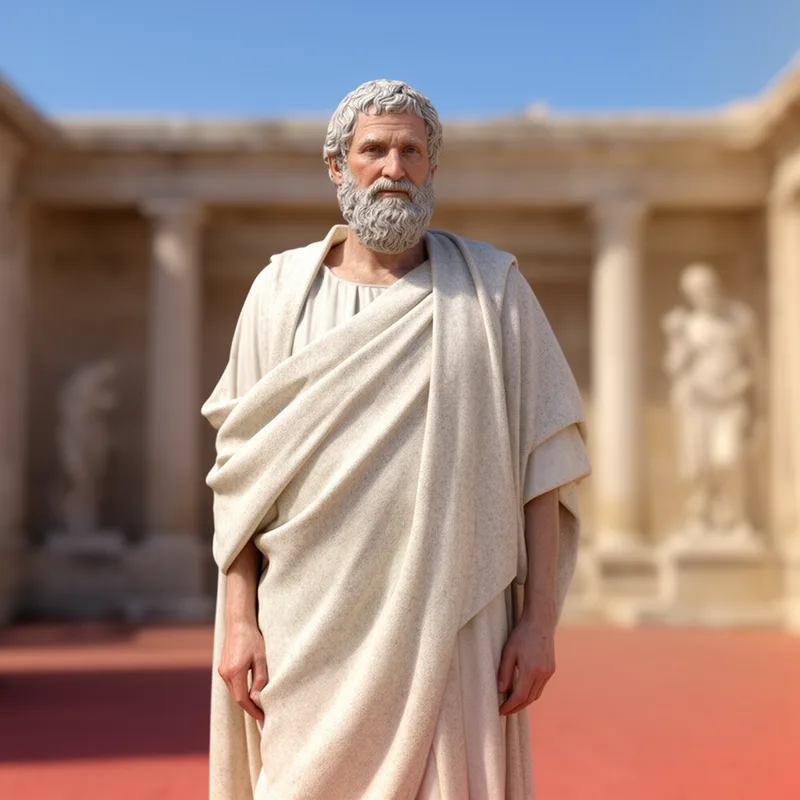
himation
- noun
- /hɪˈmeɪʃən/
- Archaic
 :
himatión
:
himatión
- In ancient Greece, philosophers often draped their himation while discussing ideas in the agora.
Examples
-
Compared to most of Raphael's figures (such as Plato and Aristotle), who are rather richly dressed, this man, with his simple, bare-shouldered himation, gives the impression of far more modest tastes.
Academic text (1995) -
As the temperatures dropped, he wrapped his himation around himself for warmth.
-
She wore a flowing himation that billowed gracefully as she walked through the marketplace.
Synonyms

 61
3.2
61
3.2

A loose outer coat that fastens at the neck and hangs down the back


 1
4.1
1
4.1
A long coat with a hood that you pull over your head

An old cloak worn over the shoulders for warmth

A wool cloak worn over the shoulders by men in ancient Rome

A small cloth used to wrap people or objects
Surface Forms
Etymology
The word himation comes from ancient Greek himation, which meant 'cloth' or 'garment' and was a large rectangular wrap people wore over their tunics. So a himation is the big cloak or shawl that ancient Greeks used as an outer garment.