
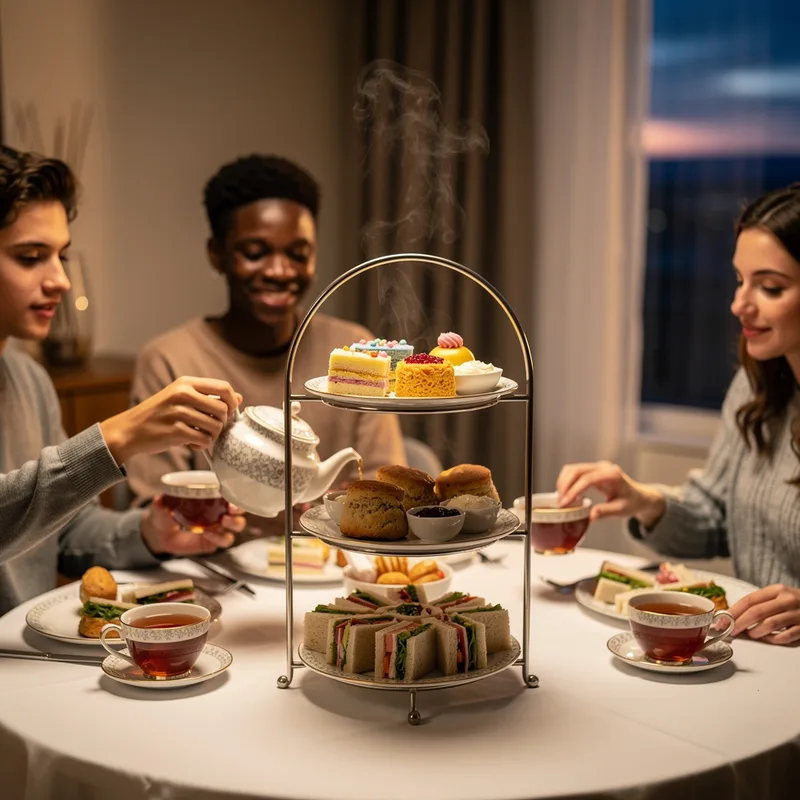
high tea
 5
3.3
5
3.3

- noun
- /haɪ tiː/
- UK
- We enjoyed a lovely high tea that included sandwiches, pastries, and freshly brewed tea.
- high tea is served
- afternoon high tea
- enjoy high tea
Loading YouTube…
Watch on YouTubeI am today I'm going on a girls date and I'm having high tea and I've got a couple of meetings.
- I am today I'm going on a girls date and I'm having high tea and I've got a couple of meetings.
- Now, the Dorchester is one of the top four or five hotels, historic hotels in London, famous for its high tea.
Examples
-
At 4 PM, guests are invited to high tea before cocktails and then dinner and dancing later this evening.
Blog text (21) -
This elegant room made me think of having high tea with a favorite aunt.
Blog text (22) -
The English and their high tea.
Fiction book (2000) -
Everyone at the studio ate a huge lunch and high tea, ordered in from a variety of places.
Fiction book (1990) -
Sunday morning, however, my father and I were up bright and early, off to high tea at the Drake.
Blog text (14) -
The tea room was going to be open the next day, and I knew someone would be busy prepping for high tea the next morning.
Blog text (11) -
I hoped my hosts at Wyrdhurst Hall would hold high tea for me because it looked as though I might be a bit late.
Fiction book (2001) -
My friend Eliza was to take the subway up the East Side and meet me in the lobby of the museum; after seeing the works, we would repair to the Stanhope Hotel for afternoon high tea.
Fiction book (2001) -
At the fancy restaurant, high tea is served with a selection of cakes and scones.
-
She invited her friends over for high tea, complete with tea, biscuits, and other snacks.
How Substantial

Surface Forms
Morphology
The meaning (a substantial early-evening meal) is not directly predictable from 'high' (superior/elevated) + 'tea' (the drink), because 'high' does not encode time or meal size; at best it suggests a more formal or elevated variety of tea. This gives partial cues but requires cultural/idiomatic knowledge and shows regional variation, so learners who only know the constituents may guess something like a fancier tea but not the precise meal sense.
Etymology
High tea may come from a simple picture: working people sat at a high dining table after work and ate a big meal with tea, while richer people had light 'afternoon tea' on low sofas. That's why high tea now means a big early-evening meal with tea and several foods.