
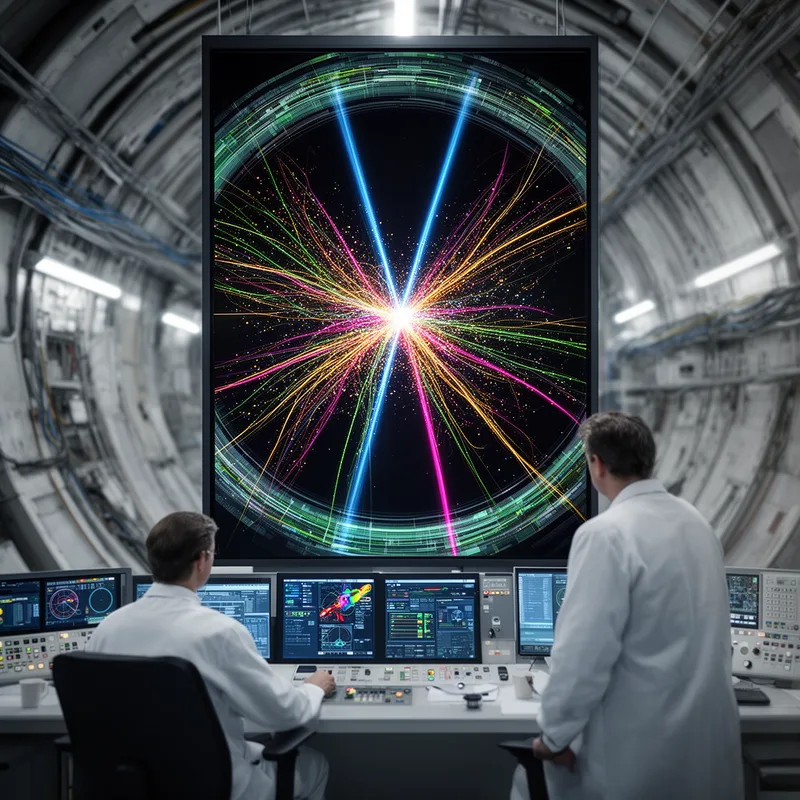
high-energy physics
- noun
- /haɪ ˈɛnərdʒi ˈfɪzɪks/
- Specialized
- The study of high-energy physics has led to significant advancements in our understanding of particle interactions.
Examples
-
The termination of that project spells the end of an era for high-energy physics in the US.
Academic text (1993) -
Their complexity is comparable to the largest detectors in high-energy physics.
Academic text (1999) -
And everyone seems to believe that some of the most exciting aspects of high-energy physics are to be found in astrophysics.
Academic text (1993) -
I think we will see a slowdown and lack of invention in accelerator physics for high-energy physics.
Academic text (2006) -
At the height of its success, the privileged standing of high-energy physics and the reductionism that permeated the field were attacked.
Academic text (1993) -
Together, these two trends have produced a deep sense of unease that has permeated the discipline, and particularly the high-energy physics community.
Academic text (1993) -
Like SLAC, DESY will close a high-energy physics facility in the lead-up to building its XFEL.
Academic text (2006) -
Those successes also provided a justification for claiming the fundamental nature of high-energy physics activities and furnished a basis for arguing its relevance to other areas of science.
Academic text (1993) -
During the Cold War, national prestige and national security could be invoked to justify the large outlays connected with experimental high-energy physics and other "fundamental" areas.
Academic text (1993) -
"For high-energy physics generally, as a community, the number of spigots is decreasing," says Persis Drell, SLAC's associate director for research.
Academic text (2006)
Synonyms

 8
4.5
8
4.5

The science that studies very small parts of matter and how they interact
Surface Forms
Morphology
high-energy + physics
The phrase is fully compositional: 'high-energy' (involving a large amount of energy) modifies 'physics', so a learner who knows 'high', 'energy', and 'physics' can infer it refers to physics concerned with high energies. The precise technical scope (e.g., particle/subatomic focus) may be specialized, but the overall meaning is transparently derived from its parts and mirrors similar constructions in other languages.
Etymology
The term high-energy physics comes from the image of scientists making very small particles go very fast—'high energy'—and smashing them to see what they are made of. The word physics is the study of matter and forces, so the name now means the part of physics that studies tiny particles and their interactions using very large energies.