
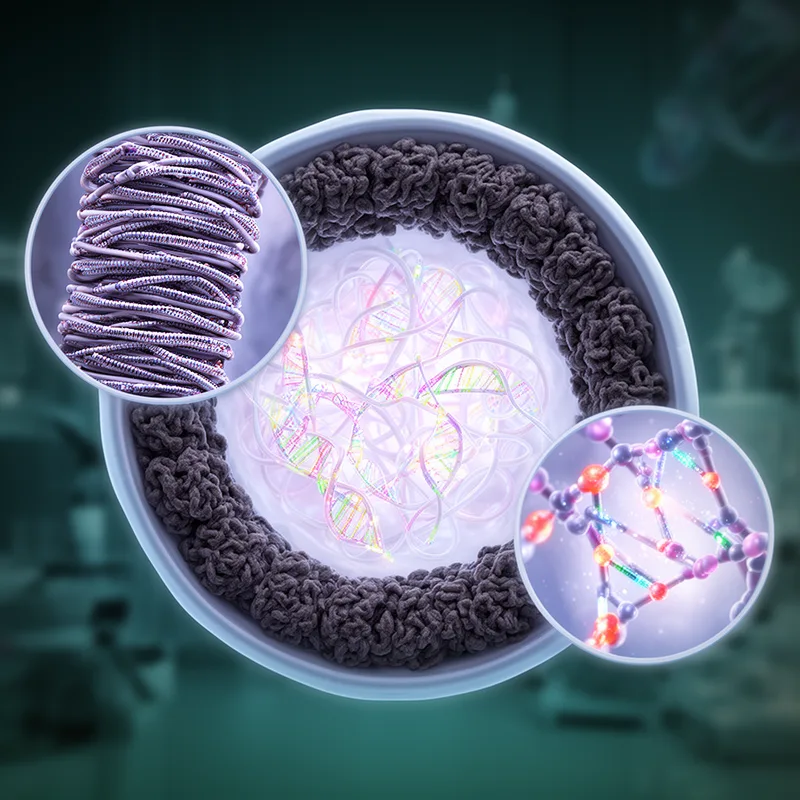
heterochromatin
- noun
- /ˌhɛtərəˈkroʊmətɪn/
- Specialized
 :
heterocromatina
:
heterocromatina
- The study revealed that the presence of heterochromatin plays a crucial role in maintaining genomic stability.
Examples
-
Heterochromatin (as opposed to euchromatin) is highly condensed, which makes it bind firmly to certain dye molecules (Mitchison and Salmon 2001).
Academic text (2009) -
One reasonable prediction would be that many of the duplicated regions would be silenced in heterochromatin.
Blog text (27) -
With the advent of chromosome banding, centromeric heterochromatin became observable.
Academic text (2009) -
Loss of the inactive X and abnormalities of XIST expression may be indicative of more general heterochromatin defects 124.
Blog text (18) -
The short arms of four chromosomes are entirely heterochromatic, but in the remaining 16 chromosomes with potentially gene-rich euchromatic arms, the heterochromatin is restricted to pericentromeric regions.
Blog text (27) -
Whether a newly arrived foreign sequence attains functionality probably depends on its features (for example, length of the acquired DNA, GC content, codon usage, genetic code, and epigenetic marks) and the position of where the sequence is integrated in the genome (heterochromatin or euchromatin).
Academic text (2018) -
In the cell nucleus, regions rich in heterochromatin are usually inactive in gene expression.
-
Heterochromatin is a tightly packed form of DNA that helps organize and protect genetic material within the cell nucleus.
Antonyms

How Condensed
- Specialized

- Specialized
Surface Forms
Morphology
Etymology
The word heterochromatin comes from the parts hetero- 'different' and chromatin 'color', because this DNA stains a different color under a microscope. So, heterochromatin is the part of a cell's DNA that looks different, is tightly packed, and is usually 'turned off' so genes there are not active.

