
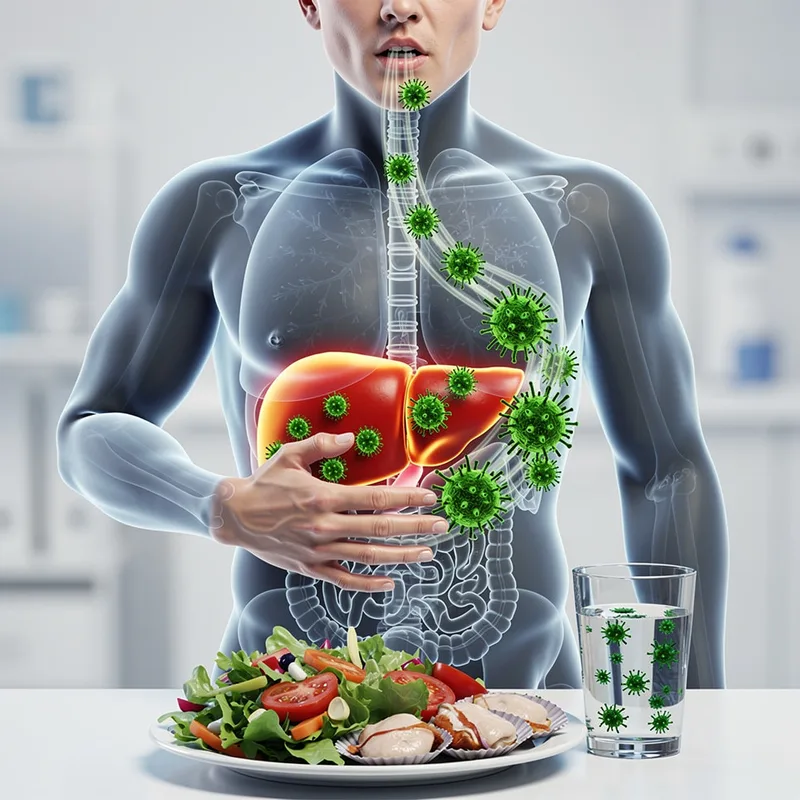
hepatitis A
 3
4.5
3
4.5

- noun
- /ˌhɛpəˈtaɪtɪs eɪ/
- Specialized
- Individuals can protect themselves against hepatitis A by receiving a vaccine, especially before traveling to areas where the virus is common.
- hepatitis A virus
- hepatitis A vaccine
- hepatitis A outbreak
Examples
-
Hepatitis A occurs at a rate of 0.1 to 1.0 per 1,000 travelers to developing countries.
Academic text (2007) -
No additional restaurant employees were ill, and no additional reported cases of hepatitis A were associated with the ill employee.
Academic text (2006) -
No additional restaurant employees became ill, and no secondary cases of hepatitis A were reported within the community.
Academic text (2006) -
However, Hepatitis A is a disease that results from poor sanitary conditions.
Academic text (2009) -
Common symptoms associated with hepatitis A include nausea, vomiting, diarrhea, abdominal pain, fatigue, anorexia, fever, jaundice, and dark urine.
Academic text (2007) -
Last year, health officials reported an outbreak of hepatitis A linked to contaminated food in several restaurants.
-
After the outbreak, the local government increased awareness campaigns to educate people about the risks of hepatitis A transmission.
Synonyms

A short, often mild liver illness caused by a virus and spread by dirty food or water
Antonyms


Surface Forms
Morphology
The headword is transparently compositional: 'hepatitis' already denotes a liver disease, and 'A' functions as a subtype label, so a learner who knows both constituents can infer this is a specific form/type of hepatitis. The use of letters to label disease strains/subtypes is cross-linguistically common, so the basic meaning (a particular hepatitis caused by the A-type virus) is clear even if detailed transmission features are not fully predictable.
Etymology
Hepatitis A comes from two parts: hepato- means 'liver' and -itis means 'inflammation' or 'sickness'. The 'A' shows the particular virus, so the name literally says 'A-type liver sickness', which helps you remember it is a contagious liver infection that often spreads through dirty food or water.