

hemostasis
 2
7.9
2
7.9

- noun
- /hɪˈmoʊstəˌsɪs/
- Specialized
- In all likelihood, the most important step in preventing a hematoma is meticulous hemostasis rather than drainage.
- achieve hemostasis
- provide hemostasis
- intraoperative hemostasis
Examples
-
However, the patient lost nearly 1,000 ml of blood before hemostasis could be achieved.
Academic text (1998) -
The incision was sutured after complete hemostasis was ensured.
Academic text (2005) -
One of these patients required further surgery to achieve hemostasis, and the other two were managed conservatively.
Academic text (2001) -
At the conclusion of each procedure, hemostasis was achieved meticulously.
Academic text (2006) -
However, they still needed to use intermittent electrocautery in most cases for hemostasis.
Academic text (2004) -
For many, electrosurgery replaced the scalpel because it provides for rapid hemostasis.
Academic text (2004) -
Platelets are believed to play an important role in primary hemostasis, wound healing, and re-epithelialization.
Academic text (2003) -
The device is designed to rapidly perform precise dissection or excision with an element of hemostasis via the plasma.
Academic text (2004) -
After appropriate exposure, the tumor was dissected from a normal-appearing cricoid with meticulous hemostasis.
Academic text (2008) -
During the operation, the surgeon carefully monitored for hemostasis to ensure no further bleeding occurred.
Synonyms
 2
3.6
2
3.6
A process in which blood becomes a thick mass to stop bleeding

Stopping bleeding during surgery using tools like a clamp
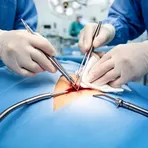
To stop bleeding during surgery using tools or medicine

Stopping bleeding or a disease quickly
Surface Forms
Morphology
Etymology
Hemostasis comes from two parts: hemo- meaning 'blood' and -stasis meaning 'standing still' or 'stop', the same root in static and stationary ('not moving'). So hemostasis literally means the stopping of blood, which is why it describes making bleeding stand still.