

hemorrhagic stroke


 1
5.6
1
5.6
- noun
- /ˌhɛmərˈhædʒɪk stroʊk/
- Specialized
- Adverse drug effects (including the primary outcome event of haemorrhagic stroke) were reported by 147 (22%) patients in the aspirin group and by 123 (18%) patients in the placebo group (Table IV).
Examples
-
High blood pressure is the single most important risk factor for stroke, increasing the risk of both ischaemic and haemorrhagic strokes.
Academic text (2012) -
But if depending on this type of stroke, it is like hemorrhagic strokes you can't do because that's a bleed.
-
Although even if there is a negative association, the total cholesterol levels required for any substantial increase in hemorrhagic stroke may be very low.
Academic text (1995) -
Thus, a positive association with occlusive stroke could be counterbalanced by a negative association with haemorrhagic stroke.
Academic text (1995) -
But if depending on this type of stroke, it is like hemorrhagic strokes you can't do because that's a bleed.
-
For example, hemorrhagic stroke and ischemic stroke hospital admissions, both of which would be classified as cerebrovascular diseases, showed opposite relationships to temperature increases in California (Green et al. 2009).
Academic text (2012) -
Indeed, in the present study, even among Asian populations with generally low total cholesterol and high proportions (about 50% or more) of hemorrhagic stroke, there was no significantly increased risk of stroke at low total cholesterol concentrations.
Academic text (1995) -
Moreover, unlike other NOACs, rivaroxaban used in AF did not have a decreased risk in hemorrhagic stroke, all-cause mortality, and ICH risk, compared with VKAs.
Academic text (2017) -
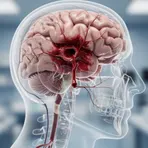
A hemorrhagic stroke occurs when a blood vessel in the brain ruptures, causing bleeding.
-
Doctors often warn that high blood pressure significantly increases the chances of experiencing a hemorrhagic stroke.
Synonyms
 232
3.7
232
3.7
A sudden loss of movement, speech, or thinking when blood stops flowing to part of the brain
 6
7.3
6
7.3
Bleeding inside the brain from a burst blood vessel
 1
5.8
1
5.8
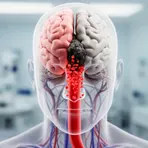
A sudden event when blood flow to the brain stops and parts of the brain stop working, called a stroke
Antonyms
- Specialized
1
5.1
A stroke caused by a blood clot that stops blood flow to the brain
Surface Forms
Morphology
The term combines 'hemorrhagic' (relating to bleeding) with 'stroke' (sudden interruption of blood flow), so the meaning 'a stroke caused by bleeding in the brain' is directly derivable from the constituents. This compositional medical label mirrors equivalent forms in many languages, making it predictable for learners who know both words.
Etymology
The term hemorrhagic stroke comes from hemorrhagic, a word meaning 'bleeding', and stroke, an old word for a sudden 'attack'. It pictures a sudden 'attack' on the brain when a blood vessel bursts and causes bleeding, so the term means a stroke 'from bleeding'.