
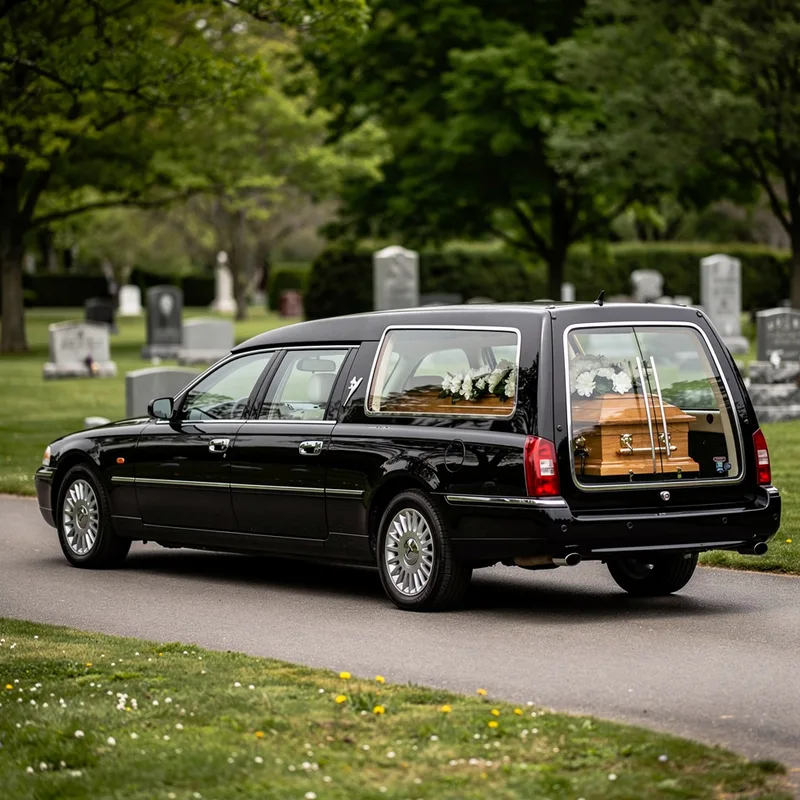
hearse
 43
7.2

- noun
- /hɪərs/
- The funeral director arranged for the hearse to be ready outside the church for the procession.
- horse-drawn hearse
Loading YouTube…
Watch on YouTubeYou know, I've never seen a, a hearse with a, with a U-Haul attached to it.
- You know, I've never seen a, a hearse with a, with a U-Haul attached to it.
- We don't have a huge marble columns location with sprawling lawns and hearses.
- I carried the Anthony Mackie and put holes in you badly, sending you off in a hearse.
- So we had a full detail of of, you know, of Army men there and they received the casket, you know, right off the plane, buried him to the hearse.
Examples
-
Having run out of vans and station wagons, the rent-a-wreck agency offered the hearse to Archie at an irresistible discount.
Academic text (2007) -
Miracolo Orientale transported the coffin in his hearse in grand style.
Fiction book (1993) -
Then, the rear door of the hearse seemed to suddenly pop open.
Fiction book (1993) -
Could you carry the child to the hearse for us?
Academic text (2010) -
We just followed a passing hearse, and here we are, you know.
-
The guys get out of the hearse and remove the coffin from the back.
Fiction book (1994) -
And so I was left with my dad's body in the room waiting for the hearse to arrive to take my father.
-
I was spying on Tommy's funeral from the groves, with your binoculars... and after everybody had left... that tall man picked up Tommy's coffin all by himself... put it in the hearse and drove off.
-
The hearse slowly drove down the street, carrying the coffin to the cemetery.
-
As the mourners gathered, the black hearse arrived to transport the deceased to the service.
How Formal

Surface Forms
Etymology
The word hearse comes from an old word herse, which meant a 'harrow' or a 'spiky frame' placed over a coffin to hold candles. Because this frame traveled with the coffin, people began to use the same word for the vehicle that carried the coffin, so a hearse is the car or carriage used at funerals.