

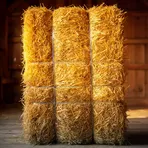
hay bale
 4
2.5
4
2.5

- noun
- /heɪ beɪl/
- As if to mock me, the gust grew in strength, sending up a flurry of straws around the hay bale.
Loading YouTube…
Watch on YouTubeYou could, you know, you could protect yourself from the winds behind a hay Bale.
- You could, you know, you could protect yourself from the winds behind a hay Bale.
Examples
-
The farmer stacked the hay bales neatly in the barn for winter storage.
-
After the harvest, we gathered the hay bales to feed the animals.
-
You were supposed to close the hay bales behind the livestock.
-
"We have to get the hay bales inside before it rains.
Fiction book (2000) -
An angry dog blocks the brothers' path across a small field spotted with hay bales.
Blog text (16) -
They'll put hay bales on the track to protect you during the race.
-
There was a red and white bull's-eye target tacked to a hay bale ten yards away.
Fiction book (2001) -
Oh, how I adore pictures of round hay bales, especially that last one with the mist and the fall colors!
Blog text (16) -
The flies may be breeding in hay bale litter that has mixed with mud, water, and manure.
Academic text (2003) -
The gust picked that moment to die, and my arrow sailed right past the hay bale, missing by an embarrassing distance.
Fiction book (2001)
Synonyms
 37
3.0
37
3.0
A large tightly bound bundle of material like hay or paper
How Big

Surface Forms
Morphology
The meaning is directly compositional: 'hay' (cut, dried grass for feed) + 'bale' (a large bundle) combine to mean a large bundled package of hay. This straightforward noun–noun compound pattern is common across languages and follows normal English compounding, so a B1 learner who knows both words will readily infer the MWE's meaning.
Etymology
Hay bale comes from farming: farmers pack loose hay into a tight bale, a big bundle. That's why the term means 'a large bundle of hay used for storage or transport'.