
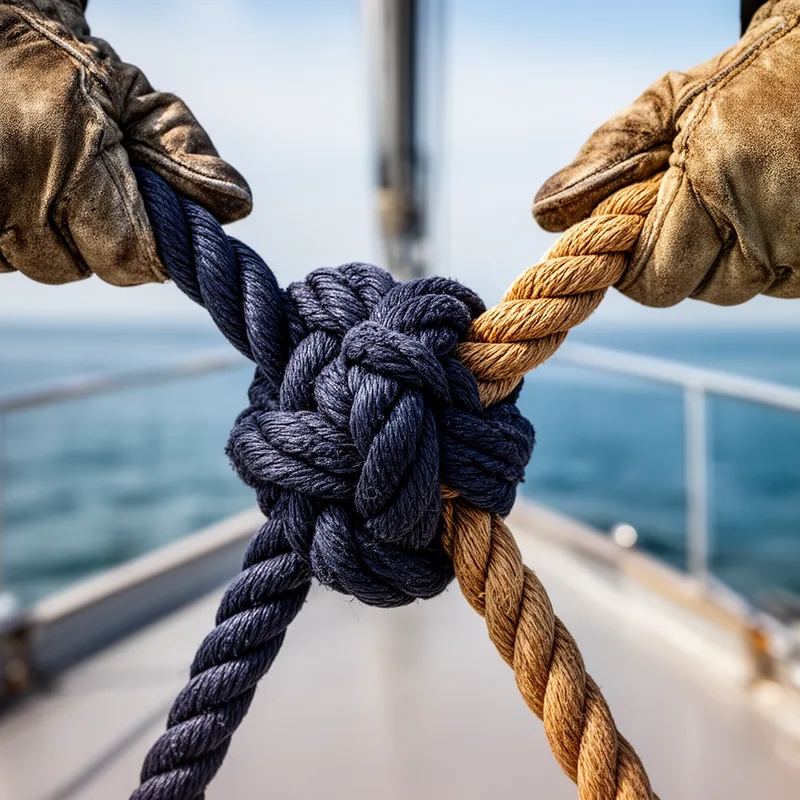
hawser bend
- noun
- /ˈhɔːzər bɛnd/
- Specialized
- The sailors used a hawser bend to join the two thick mooring lines together.
Examples
-
Before towing the boat, he secured the ropes with a hawser bend to ensure they would not come apart.
-
Learning to tie a strong hawser bend is essential for working with heavy-duty cables at sea.
-
The sailor tied a hawser bend to secure the boat.
-
Can you show me how to tie a hawser bend?
-
Before towing the boat, he secured the ropes with a hawser bend to ensure they would not come apart.
-
Learning to tie a strong hawser bend is essential for working with heavy-duty cables at sea.
-
The sailors used a hawser bend to join the two thick mooring lines together.
Synonyms


 1
6.1
1
6.1
A way of tying two fishing lines together so they hold well
 1
8.6
1
8.6
A knot people who fish use to join two lines by wrapping the ends together
 1
8.4
1
8.4
A knot used to join one rope to another, even when they are different thicknesses

A strong knot used to join the ends of two large ropes often on ships
A way of joining two ropes used as a symbol of love

A knot used to join the ends of two ropes so they stay together

A strong knot for joining two fishing lines by wrapping their ends

A way of tying two rope ends by crossing them left then right to hold bandages or sails
A knot that ties one rope to the middle of another rope or to a loop

To tie one rope or thread temporarily to the middle of another rope to join them
How Secure
- Specialized

- Specialized
1
6.1
- Jargon
1
8.4
- Specialized
1
4.4
Surface Forms
Morphology
Although 'hawser' (a heavy rope) and 'bend' (commonly 'a curve') are individually understandable, the term uses a specialized nautical sense of 'bend' meaning 'a knot for joining ropes'. A B1 learner who only knows the ordinary sense of 'bend' would not predict the technical meaning 'knot used to join two ropes', so the expression is not transparently compositional.
Etymology
Hawser bend comes from two simple images: hawser, a very thick rope, and bend, a sailor's word for a knot that 'joins' ropes. That's why Hawser bend means a strong knot used to 'join' two heavy ropes.