

hawk owl
- noun
- /hɔk aʊl/
- Specialized
- While hiking in the woods, I spotted a hawk owl perched on a branch, scanning the ground for prey.
- hawk owl from the northern regions
- hawk owl diet
- hawk owls in Scandinavia
Examples
-
The hawk owls of Alaska and Canada are about 6 percent larger than Scandinavian birds.
Academic text (2003) -
The hawk owl, its mate, and their young feasted on duck for days.
Academic text (2003) -
In the course of our work, we were able to expand the story of New World hawk owls.
Academic text (2003) -
With the help of some volunteers, we found nine nests, the most ever included in a single hawk owl study.
Academic text (2003) -
My first encounter with a northern hawk owl came early in my career, on a cold day in mid-May.
Academic text (2003) -
When readily available, voles account for most of the hawk owl's diet.
Academic text (2003) -
Unlike other owls, hawk owls depend more on vision than hearing when they hunt.
Academic text (2003) -
No matter where hawk owls raise their young, breeding coincides with the availability of prey.
Academic text (2003) -
Hawk owl eggs, like the two in this nest, hatch after about thirty days of incubation.
Academic text (2003) -
Fortunately, my enthusiasm for hawk owls spread to my colleagues in the long-term ecosystem project.
Academic text (2003)
Synonyms
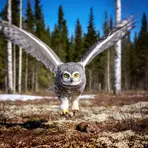
A grey and white owl that hunts during the day in northern forests and open woodlands
Surface Forms
Morphology
The meaning is directly compositional: a B1 learner who knows 'hawk' and 'owl' can infer that this denotes an owl with hawk-like characteristics (diurnal, raptor-like). Noun–noun compounds that describe one animal by reference to another are common cross-linguistically, so the sense is predictable from the constituents.
Etymology
Hawk owl comes from how the bird looks and acts: it is an owl that looks like a hawk and hunts in the 'day'. So the name points to its hawk-like shape and daytime hunting, which makes this bird different from most other owls.

