

to have words (with)
 119
7.5
119
7.5

- idiom
- Informal
- After the meeting, they had words over the team's performance.
- have a few words with
- have a couple of words with
Examples
-
I need to have words with my colleague about the project's deadline.
-
Let's have words about your behavior during the presentation.
-
"Did you by any chance have angry words with your father this morning?"
Fiction book (1996) -
Do you mind if I have a word with him alone for a minute?
Fiction book (1991) -
I'm sorry to be calling so late, but I need to have a few words with you on a very important matter.
-
Sir Robert said he would follow as soon as he had a word with Travis and Mrs. Cox.
Fiction book (1993) -
Mr. Tiede, may we have a word with you?
-
Capt. Baker would like to have a word with you.
-
Mr. Bliss, I'd like to have a word with you, if I may.
Fiction book (1992) -
– Harry, can I have a word with you outside?
Synonyms
 607
1.1
607
1.1
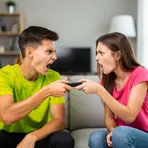
To speak angrily with someone because you disagree
 36
2.9
36
2.9
To talk with someone because you disagree about something
 35
2.6
35
2.6
To argue angrily with someone about small things
 11
6.9
11
6.9
Talk angrily to someone because of a disagreement
 5
7.1
5
7.1
To argue in a friendly, quick way without serious anger
 5
6.8
5
6.8
Argue strongly with someone, often in public
 2
2.8
2
2.8
Argue with someone and feel angry or upset afterward


 1
7.2
1
7.2
To tell someone you are unhappy with them in an angry way

Tell someone angrily that you are unhappy with them
Antonyms


How Angry
35
2.6

- Informal
119
7.5
607
1.1
- Formal
∞
2.0
∞
1.6
Surface Forms
Morphology
The meaning is linked to the constituents — 'have' (possess/experience) plus 'words' (an exchange of speech) — so a learner can infer it involves speaking with someone. However, the specific sense of a brief angry or heated exchange is an idiomatic/pragmatic extension of 'words' that is not fully predictable from the literal meanings, so prior exposure is usually needed to know it denotes an argument.
Etymology
Have words (with) comes from the image of two people exchanging sharp words like small hits. When you have words with someone, you fight with language, so today it means 'to argue' or 'to have an argument with' someone.