
hartshorn


 1
9.9
1
9.9
- noun
- /ˈhɑrtˌshɔrn/
- Archaic
- Photographer: W.S. Hartshorn.
Examples
-
Earle Hartshorn
Blog text (30) -
Quickly, Gideon—my hartshorn.
Fiction book (1991) -
They, likewise, give me salt of hartshorn, which I take with no great confidence, but I am satisfied that what can be done is done for me.
Blog text (28) -
Where is my hartshorn?
Fiction book (1991) -
Hartshorn.
-
Many business owners moved to the Sun Belt in search of inexpensive land, low wages, and greater accessibility to the national market (Moon 1987; Hartshorn 1997).
Academic text (2008) -
Most research on this topic has emphasized common species because these are the species for which sufficient sample sizes are available (Hartshorn 1975, Lieberman and Lieberman 1987).
Academic text (1992) -
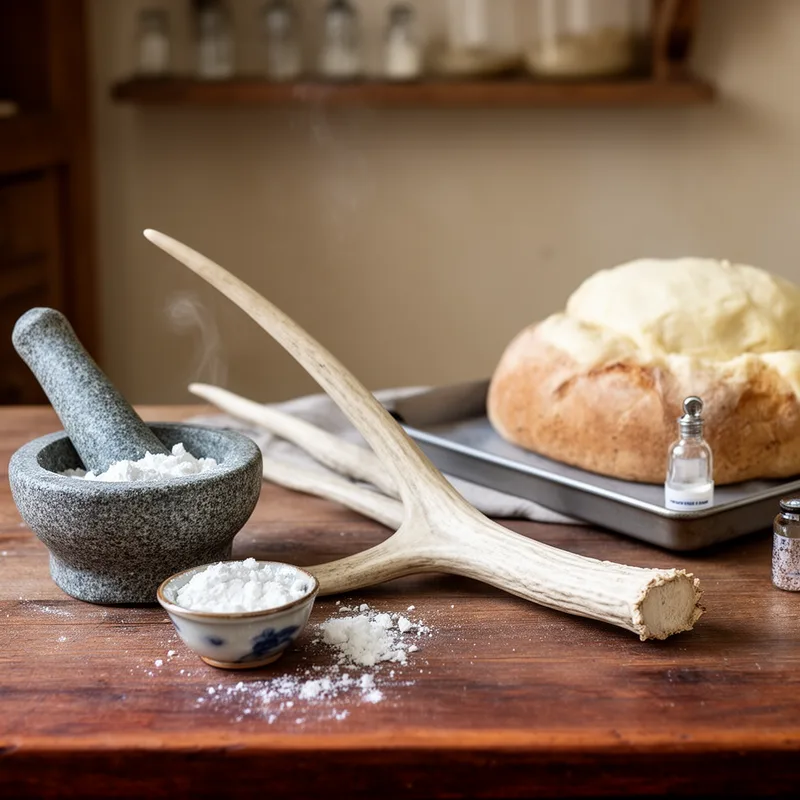
In traditional medicine, hartshorn was often used as a remedy for faintness.
-
Some bakers still prefer to use hartshorn in their recipes as a leavening agent.
-
Hartshorn is derived from the antlers of male deer and has been used for centuries in various healing practices.
Synonyms
 41
3.7
41
3.7
A branched horn on a deer that falls off and grows back each year
 1
8.5
1
8.5
A hard material made from a deer's antler used for handles and decorations

The antler of an elk or a piece of that antler used for handles and decoration
Surface Forms
Morphology
Etymology
Hartshorn comes from the old parts hart and horn, where hart means 'deer' and horn means 'horn', so it first meant a deer's antler. Over time, hartshorn came to mean the white salt made from heated antlers that bakers and medicine makers used to make bread rise and for smelling salts.