
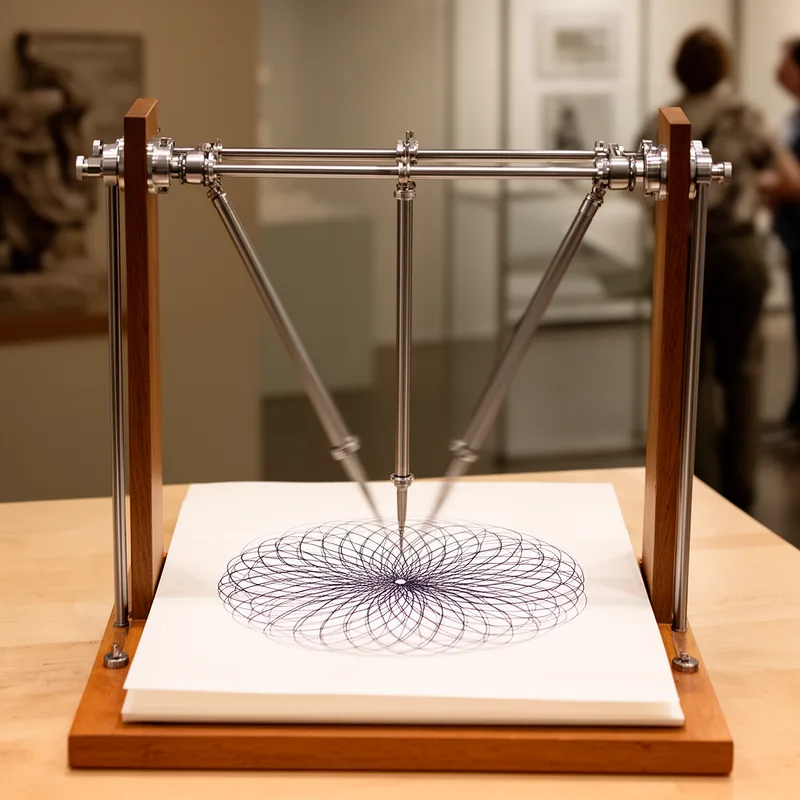
harmonograph


 1
9.9
- noun
- /ˈhɑːrmənəˌɡræf/
- Archaic
- During the demonstration, the harmonograph drew complex shapes as the pendulums swung back and forth.
Examples
-
This invention, called the harmonograph because it made a written record of the harmony of the pendulums, caught on like wildfire.
Blog text (19) -
At the science fair, students displayed their harmonographs to show how pendulums could produce beautiful designs.
-
You can, of course, build your own harmonograph today.
Blog text (19) -
The harmonograph was the first art machine.
Blog text (19) -
Victorian parties were often enlivened by a simple device called a harmonograph.
Blog text (19) -
In the end, the harmonograph was no threat to art—or at least not as much a threat as human performance artists were—but it was one of the first signs that human artistry was in for tougher competition than had previously been thought.
Blog text (19) -
The artist used a harmonograph to create intricate geometric patterns on paper.
Surface Forms
Morphology
Etymology
Harmonograph comes from harmony ('agreement' or 'pleasant sound') and graph ('to write' or 'draw'), so it can be seen as 'writing harmony'. A harmonograph is a machine with swinging parts (pendulums) that move together and draw beautiful repeating patterns on paper.