
halocarbon


 1
8.2
- noun
- /ˈhæloʊˌkɑrbən/
- Specialized
- Many halocarbons contribute to climate change due to their greenhouse gas properties.
Examples
-
Even considering their higher direct GWP, halocarbon refrigerants appear to offer the most complete solution by fully meeting all the safety, performance, economic, and environmental constraints that are placed on today's refrigerants.
Academic text (1998) -
Researchers are studying the impact of halocarbons on the ozone layer to find sustainable alternatives.
-
DIAGRAM: When considering appropriate halocarbon alternatives, engineers need to strike a balance between key constraints.
Academic text (1998) -
Some greenhouse gases, or GHG, such as industrial halocarbons, are made only by humans.
Blog text (32) -
Due to halocarbons' level of GWP, some European countries have begun exploring alternatives to them.
Academic text (1998) -
All of the current halocarbon refrigerants (including refrigerant mixtures) are formulated to be Class 1.
Academic text (1998) -
Because carbon dioxide and many of the halocarbons have very long atmospheric lifetimes, the increased concentrations are likely to result in an enhanced greenhouse effect in the future.
Academic text (2008) -
One of the major challenges in identifying halocarbon alternatives to ozone-depleting substances is to strike a balance between the various affecting factors, namely ODP, TEWI, toxicity, flammability, performance characteristics, and cost.
Academic text (1998) -
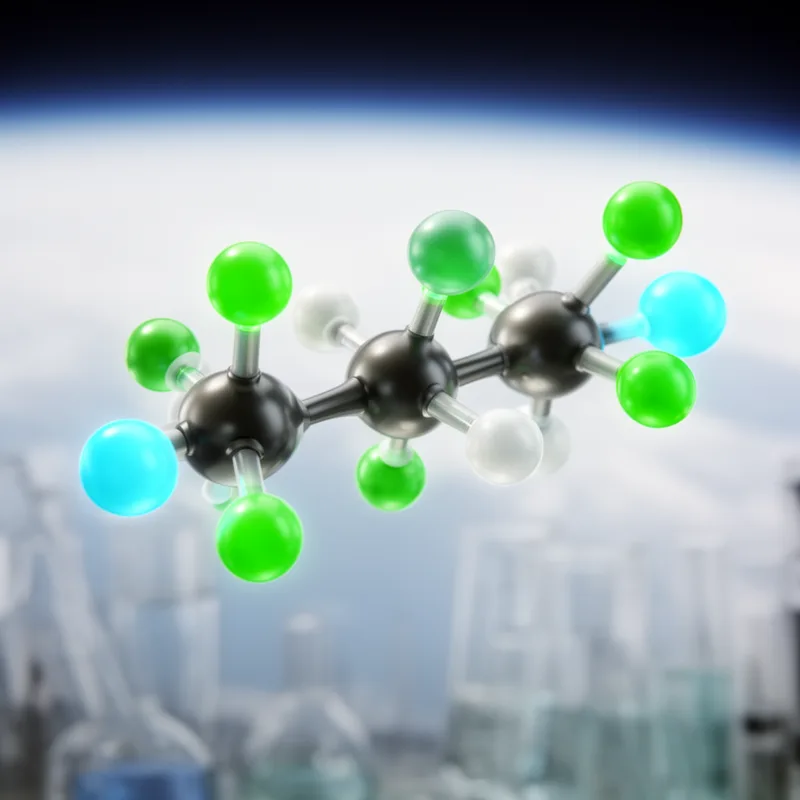
CFCs are a subcategory of halocarbons, which are compounds of carbon and one or more of the following halogens: fluorine, chlorine, bromine, or iodine.
Academic text (1991) -
Halocarbons, such as CFCs and HFCs, are chemical compounds that contain carbon bonded to halogen elements.
Surface Forms
Morphology
Etymology
Halocarbon is made of the parts halo and carbon, where carbon is the common element in many compounds and halo comes from an old Greek word meaning 'salt'. So, in chemistry 'halo' points to elements like 'chlorine' or 'fluorine', and a halocarbon is a carbon-based molecule with one or more of these elements attached.