
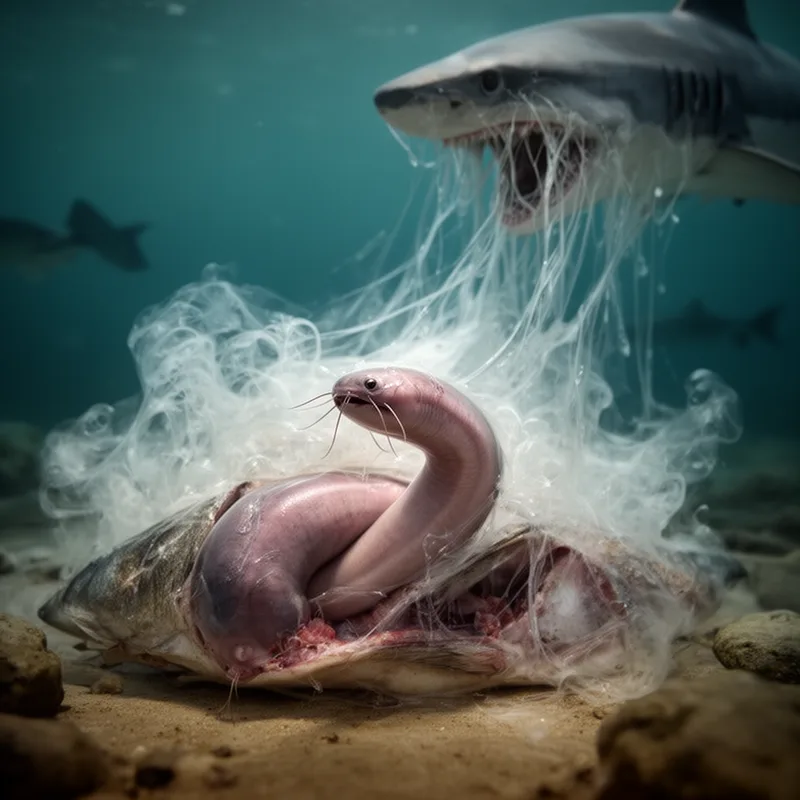
hagfish


 1
9.9
1
9.9
- noun
- /ˈhæɡˌfɪʃ/
- Specialized
- Table 8: Average egg length by month for Pacific hagfish females from Oregon landings, 1988 through October 1989.
- Pacific hagfish
- black hagfish
- Oregon hagfish
Loading YouTube…
Watch on YouTubeHere is how the giant larvacean one UPS the hagfish.
- Here is how the giant larvacean one UPS the hagfish.
Examples
-
The hagfish uses its round mouth and surrounding tentacles to bore into dead fish and consume them.
-
Fish tagging or marking studies would be useful in determining hagfish longevity and growth rates.
Academic text (1993) -
About 48% of the black hagfish caught in these traps were mature.
Academic text (1993) -
There is no apparent market at present for either black hagfish skin or the edible flesh of either species.
Academic text (1993) -
Males comprised 30% of the mature Pacific hagfish and 39% of the mature black hagfish.
Academic text (1993) -
In 1992, only one vessel fished for hagfish off Canada, and there was only one buyer.
Academic text (1993) -
The permit authorized the use of hagfish traps approved by ODFW.
Academic text (1993) -
A sustained fishery has not developed, and while black hagfish were plentiful, few Pacific hagfish were caught.
Academic text (1993) -
Two species of hagfish are commonly found off Oregon: Pacific hagfish, Eptatretus stouti, and black hagfish, E. deani.
Academic text (1993) -
In 1990, 11 vessels landed 75,924 kg of hagfish from 102 trips.
Academic text (1993)
Synonyms
 1
9.9
1
9.9
A long eel-like sea animal with a round mouth and tentacles that eats dead fish by boring into them

A sea animal like an eel without jaws that makes lots of slime and eats dead fish
Surface Forms
Morphology
Etymology
Hagfish is simply hag + fish, where hag once meant 'witch' or an ugly old woman. A helpful way to remember it is that people thought these slim, eel-like fish looked scary and witchlike, so the name stuck and now hagfish means a slimy sea fish that eats dead or dying animals.