
hemolytic
 3
9.1
3
9.1

- adjective
- /ˌhiːməˈlɪtɪk/
- Specialized
- Those are the autoimmune, hemolytic anemias, thrombocytopenia, things like that.
- hemolytic anemia
- beta-hemolytic
- hemolytic streptococci
Examples
-
Disease onset in the proband was at age 16 months, when she developed a fever, hemolytic anemia, and thrombocytopenia.
Academic text (2003) -
The highest value reported was 1,486 IU from a deployed dog undergoing glucocorticoid treatment for immune-mediated hemolytic anemia.
Academic text (2010) -
Acquired hemolytic anemia is best treated by identifying and removing the cause.
Academic text (2003) -
No signs of encephalitis or hemolytic uremic syndrome were found.
Academic text (2012) -
The majority of the infections are caused by Group A beta-hemolytic streptococci.
Academic text (1995) -
There were more than 500 laboratory-confirmed cases, mostly in children, of whom 47 developed hemolytic uremic syndrome and four died.
Academic text (2002) -
Growth of Staphylococcus aureus or hemolytic streptococci was found to be associated with delayed wound healing in EMCLU's patients.
Academic text (2007) -
Both episodes were characterized by severe hemolytic anemia and acute renal insufficiency and resolved without plasma treatment, with no renal sequelae.
Academic text (2003) -
Our aim was to investigate if there is an association between group A beta-hemolytic Streptococcus infection and acute myocardial infarction (AMI).
Academic text (2007) -
Children with hemolytic anemia often need frequent blood transfusions to maintain their health.
Synonyms

Damaging blood cells and vessels, often causing internal bleeding
Compounds

- Specialized
2
5.4
A condition causing too few red blood cells because they break down fast
Surface Forms
Morphology
hemolytic = hemo + lytic
Formed from technical combining forms ('hemo-' + '-lytic') which create a regular adjectival meaning in medical contexts but remain unfamiliar to average B1 learners.
Etymology
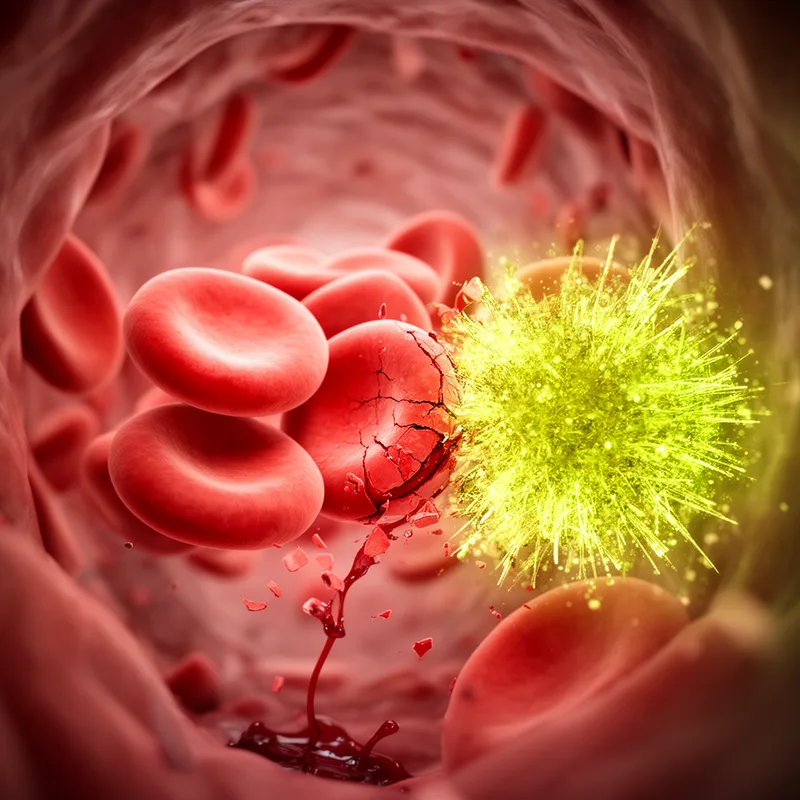
Hemolytic comes from Greek parts hemo- meaning 'blood', as in hemoglobin, and -lysis meaning 'breaking'. So something hemolytic literally 'breaks' blood cells, which is why it means it causes red blood cells to be destroyed.