

great toe
- noun
- /ɡreɪt toʊ/
- the left great toe
Examples
-
There may also be preaxial polydactyly, which occurs when there is duplication of the great toe.
Academic text (2005) -
In our study, there was a decrease in plantar loading under the metatarsal heads (first, fourth, fifth), the great toe, and the heel.
Academic text (1995) -
The medial or lateral torsion is measured on the goniometer clamped to the great toe.
Academic text (1991) -
The foot length was measured as a straight distance between the most posterior projecting point of the heel and the most anterior projecting point (the end of the great toe or second toe) when placed on a flat surface.
Academic text (2007) -
The average decrease was 32% under the fifth metatarsal, 63% under the fourth metatarsal, 69% under the first metatarsal, 65% under the great toe, and 45% under the heel.
Academic text (1995) -
The muscle response associated with S3 stimulation is a bellows-like inward movement of the levator ani muscle and plantar flexion of the great toe.
Academic text (2000) -
When he stubbed his foot, the pain concentrated in his great toe.
-
She carefully painted her nails on her great toe to match her summer sandals.
-
A bunion can form on the side of the great toe, causing discomfort.
Synonyms

 526
1.0
526
1.0

One of the five small parts at the end of a foot that help you balance while walking
 19
1.0
19
1.0
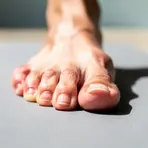
The largest toe on the inside of the foot


 1
9.9
1
9.9
The big toe at the inner side of the foot
Surface Forms
Morphology
The meaning 'the first and largest innermost toe' is directly derivable from combining 'great' (very large) with 'toe' (a digit), following a straightforward adjective+noun compositional pattern. Although 'great toe' is slightly more formal/anatomical than the everyday 'big toe', the concept is transparent and cross-linguistically common, so a B1 learner who knows both words would understand it.
Etymology
The noun great toe names the largest toe: great once meant 'big' and toe is the part at the end of your foot. Because this toe is the biggest, sits on the inside of the foot, and helps with balance, the name points to its size and importance.