

grand opera
 1
5.9
1
5.9

- noun
- /ɡrænd ˈoʊpərə/
- He had expected many students to share his love of classical music, especially grand opera, and he became convinced that the kickers, bikers, dudes, and others lacked culture and upbringing.
- grand opera house
- world of grand opera
Examples
-
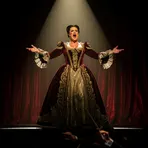
The grand opera features elaborate sets and costumes that transport the audience to another world.
-
- The third act of the grand opera.
-
The home of grand opera.
Blog text (25) -
Rome does it as grand opera.
-
I particularly liked producing grand opera because it gave scope to my skill as a singer as well.
Fiction book (1990) -
Then Eleanor had been at the height of her fame, traveling long distances all over the world for a single performance in some grand opera house, heralded as the greatest soprano of her generation.
Fiction book (1995) -
In the super-expensive world of grand opera, the company is planning a $67.1 million budget, and Gockley is cautiously optimistic about working without a deficit for the first time in three years if there is 90 percent capacity paid attendance and we raise a whopping $35 million in contributions.
Blog text (20) -
Many people love attending grand opera performances because of their emotional depth and musical richness.
-
The storyline in the grand opera was told entirely through powerful singing, leaving the audience in awe.
Synonyms
 267
4.2
267
4.2
A staged musical story in which actors sing most or all parts, often with live music
How Large

Surface Forms
Morphology
The phrase is a straightforward adjective + noun composition: a learner who knows 'grand' (magnificent) and 'opera' (a staged sung drama) will infer 'a large or splendid opera'. Although musicology uses 'grand opera' for a specific 19th-century genre (all dialogue sung and on a large scale), the core meaning is directly derivable from the parts.
Etymology
The term grand opera comes from 1800s theaters where grand meant 'large and serious' and opera meant a musical drama sung all the way through. These shows used big casts, large sets and dance scenes, so grand opera now means an opera that is large in scale and 'fully sung'.