

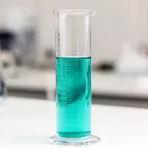
graduated cylinder


 1
5.1
1
5.1
- noun
- /ˈɡrædʒueɪtɪd ˈsɪlɪndər/
- Specialized
- The exposed internal volume of each valve was measured by filling the valve with water and emptying it into a graduated cylinder.
Examples
-
Before conducting the experiment, fill the graduated cylinder with exactly 100 milliliters of water.
-
Look at the size of this graduated cylinder: 2000 milliliters!
-
Well, uh, you can start by measuring 40 milliliters into that graduated cylinder.
-
The students will learn that different types of soils retain different amounts of water, and they will learn how to read and use a graduated cylinder.
Blog text (24) -
Dispense small volumes of stock solutions using graduated cylinders, pipettes, or plastic syringes, and dilute them to make larger volumes of nutrient solution.
Academic text (2001) -
For ease of nutrient solution preparation, first use a 1L graduated cylinder and mark the inside of the 5-gal bucket with a China marker or another permanent marker at 5- and 10-L volumes.
Academic text (2001) -
To accurately measure 50 milliliters of liquid, pour it into the graduated cylinder and read the measurement at eye level.
-
In the chemistry lab, we often use a graduated cylinder to ensure precise liquid measurements for our experiments.
Synonyms
 28
8.5
28
8.5
A glass container with marked lines for measuring liquids
How Precise

Surface Forms
Morphology
The meaning is directly composed from 'graduated' (marked with a scale) and 'cylinder' (a cylindrical container), so a learner who knows both words can infer it is a cylindrical vessel with measurement markings used to measure liquids. This is a straightforward adjective+noun construction with clear cross-linguistic parallels, making the term transparent to B1 learners.
Etymology
Graduated cylinder comes from its shape and the marked lines on the glass: graduated means marked in steps or lines, and cylinder means a tall round tube. The marked levels let you read how much liquid is inside, so the name points to a tall tube with lines used to 'measure' liquids.