

to gouge out
 5
7.4
5
7.4

- phrasal verb
- /ɡaʊdʒ aʊt/
 :
sacar a golpes
:
sacar a golpes
- The workers had to gouge out the old concrete to make room for the new foundation.
- gouged out an eye
It was as if her wild assailant, or was it assailants, had been intent on gouging out chunks of her flesh.
- It was as if her wild assailant, or was it assailants, had been intent on gouging out chunks of her flesh.
- Even if you gouge out my green tattoos with a knife.
Examples
-
We passed gullies so raw they seemed to have been gouged out of the earth by enormous pickaxes.
Academic text (2012) -
And how did the wood get gouged out?
-
The impact of the water gouged out a deep pool in the rock of the creek bed.
Fiction book (1992) -
Straight down Wilshire Boulevard is an enormous canyon, a river bottom gouged out of concrete in the big earthquake.
Fiction book (1996) -
In 1957, the county, in an attempt to enlarge the beach, chopped down 100 trees and gouged out the slope above the beach.
Academic text (1997) -
The impact itself has gouged an enormous crater out of the roadway at the midpoint across the Potomac.
Fiction book (1996) -
A chunk of skin had been gouged out—teeth or fingernail marks or a scrape against exposed brick.
Fiction book (1999) -
After hours of digging, they finally gouged out a deep trench for the drainage system.
-
The sculptor used a chisel to gouge out intricate designs from the block of marble.
Synonyms
 161
1.1
161
1.1
To cut or mark a surface by scraping it with something sharp
 62
1.2
62
1.2
To rub material off a surface with something hard or sharp
 20
7.2
20
7.2
To make a deep cut or hole in something with a sharp object
 17
9.1
17
9.1
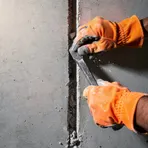
To cut a narrow groove into a wall or other surface
 8
8.9
8
8.9
Cut a groove in wood or stone with a tool
 5
4.2
5
4.2
To cut something deeply, often by accident
 2
5.1
2
5.1
To make a long narrow cut or channel in a surface

To cut deep into a surface to make patterns or letters

Make a deep hollow inside rock, like a tunnel
Antonyms

How Deep

Surface Forms
Morphology
The verb 'gouge' already denotes cutting/scooping to create a hollow, and the particle 'out' adds the directional/completive sense of removing material outward; combined, the phrase simply means to scoop or cut something out. This verb + out composition is a regular, compositional pattern in English (and paralleled in other languages), so a B1 learner who knows both words should be able to infer the meaning.
Etymology
Gouge out comes from a simple image: gouge means to dig or scrape deeply and out shows that material is removed. Imagine pushing a sharp tool into wood or metal and pulling a large chunk 'out', so it means 'to make a deep cut or groove' in a surface.