
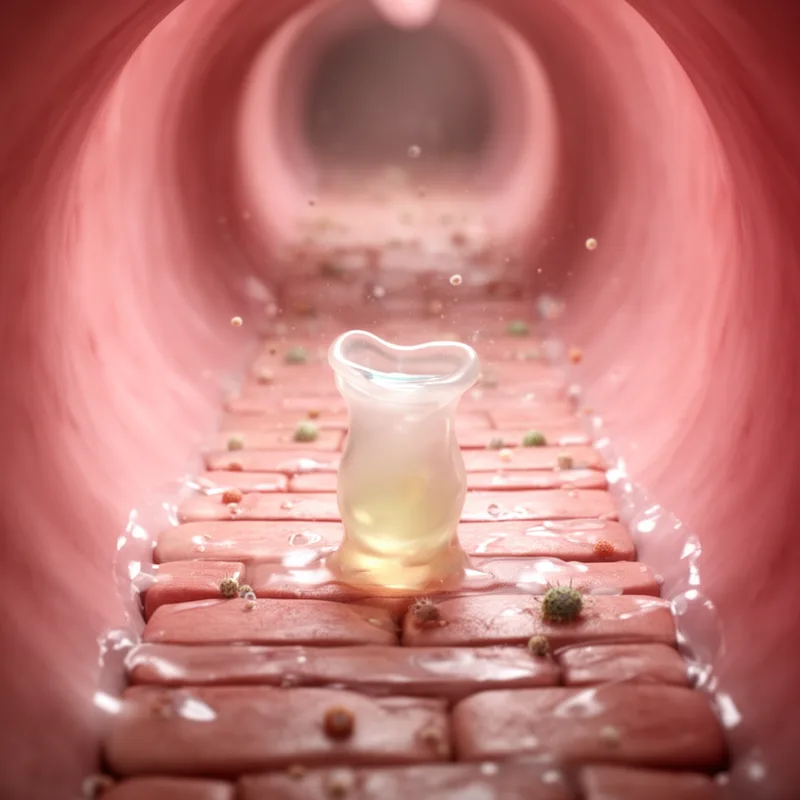
goblet cell
- noun
- /ˈɡɑːblɪt sɛl/
- Specialized
- In the respiratory system, goblet cells play a vital role by producing mucus to trap dust and pathogens.
- number of goblet cells
- goblet cells secrete
- mucosal goblet cells
Examples
-
For example, goblet cells secrete mucilage for the protection of the intestinal mucosa and serve as structural components for the intestinal mechanical barrier.
Academic text (2015) -
Regular secretions may be emitted as mucus from goblet cells in the mucosal lining of the ducts or as saliva from the pharynx.
Academic text (2008) -
Goblet cells were largely scattered among columnar cells.
Academic text (2015) -
The specimen also contained numerous goblet cells and a few islands of squamous epithelium.
Academic text (2005) -
The gut epithelium has in it dendritic cells and goblet cells and lymphocytes and things like that.
-
The goblet cells in the intestine secrete mucus that lubricates and protects its surfaces.
-
The researcher counted the number of goblet cells in the tissue sample to assess the health of the mucous membrane.
Surface Forms
Morphology
goblet + cell
The compound combines 'goblet' (a cup-shaped vessel) with 'cell' (a biological unit), so a learner who knows both words can infer a cup- or goblet-shaped type of cell. However, the specific functional sense (mucus-secreting epithelial cell) is specialized biological knowledge and not fully predictable from the constituents alone. Because form is transparent but the precise function is not, the MWE is best classed as partially transparent.
Etymology
Goblet cell is named for its shape: the cell looks like a tiny goblet, a drinking cup, that holds 'mucus'. When the cup-like top fills and releases its 'mucus', the name helps us remember that the cell makes mucus to 'protect' and keep body surfaces wet.

