
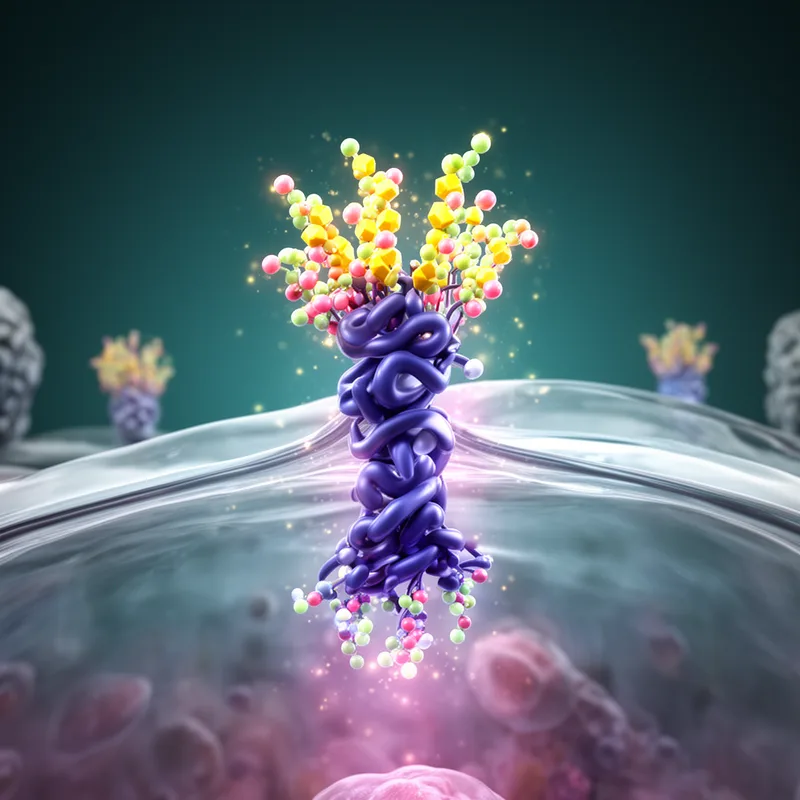
glycoprotein
 2
7.7

- noun
- /ˌɡlaɪkoʊˈproʊtiːn/
- Specialized
- Respiratory airway mucus is a complex mixture of glycoproteins, proteoglycans, lipids, lesser quantities of other proteins, and sometimes DNA.
- surface glycoprotein
- glycoprotein vaccine
- viral glycoprotein
Loading YouTube…
Watch on YouTubeIt's outside its glycoprotein more resembles Ebola virus than Arena virus.
- It's outside its glycoprotein more resembles Ebola virus than Arena virus.
- Now Manos is a common of sugar that's found in polysaccharides and glycoproteins.
Examples
-
Their surface is covered with a dense coat of a single protein, and they have variable surface glycoproteins, so they can vary their surface properties.
-
There are two glycoproteins, haemagglutinin (HA) and neuraminidase (NA), on the surface of the virus.
Academic text (2012) -
A mutant strain in which the sequences that code the viral glycoprotein have been changed slightly.
-
When the virus mutates, it alters these glycoproteins, particularly HA.
Academic text (2012) -
Antibody to these glycoproteins is required to confer immunity.
Academic text (2012) -
The development of novel glycoprotein-specific antibodies is likely to provide novel tools with high specificity and large clinical potential.
Academic text (2016) -
Envelope glycoproteins E1 and E2 are known to be critical for attachment to the target cell membrane.
Academic text (2007) -
MCP is a widely expressed transmembrane glycoprotein that regulates complement activation.
Academic text (2003) -
The capsular polysaccharide, glycoproteins, and hepta-acylated lipooligosaccharide (LOS) all contribute to the virulence of Acinetobacter baumannii.
Academic text (2018) -
The vaccine contains an Ebola glycoprotein that cannot cause disease but does trigger immunity.
Surface Forms
Morphology
Etymology
Glycoprotein breaks into glyco- meaning 'sweet' or 'sugar', as in glucose, and protein, meaning a molecule in the body, so a glycoprotein is a protein with sugar chains attached to it.