
gluon
 4
9.9

- noun
- /ˈɡluːɒn/
- Specialized
- In a matter of microseconds after the Big Bang, quarks and gluons formed protons and neutrons.
- quark-gluon
- gluon plasma
- massless gluons
Loading YouTube…
Watch on YouTubeThe strong force carried by gluons doesn't work that way.
- The strong force carried by gluons doesn't work that way.
- The strong force has gluons, the weak force has W&Z; bosons.
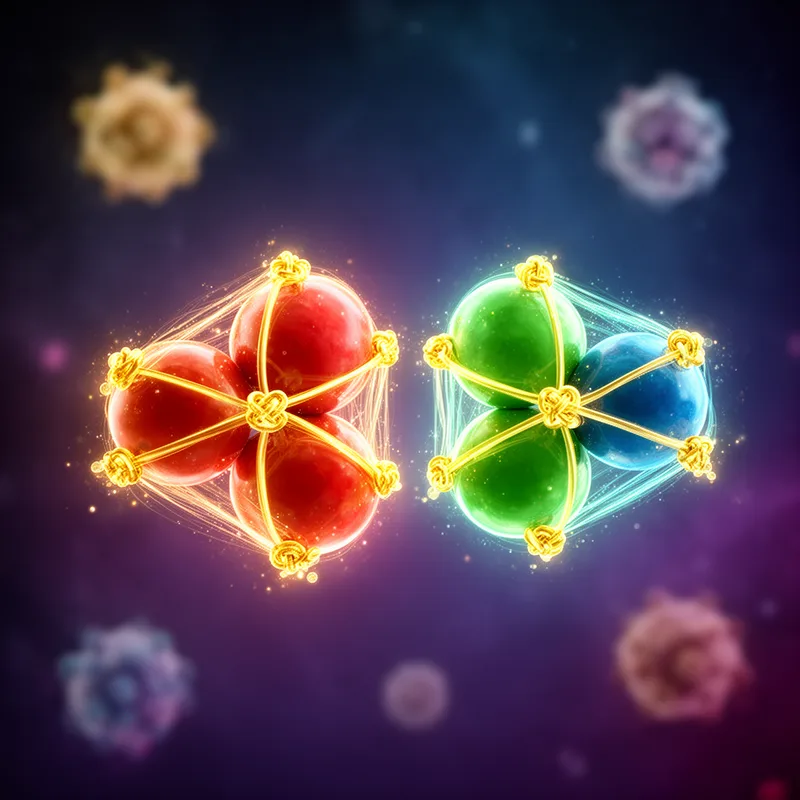
- Those are called gluons because they glue quarks together.
- We can't even calculate how quarks and gluons hold together.
- But those can have been broken down into your gluons or leptons, quarks, right?
- There's photons, there's gravitons, there are Higgs bosons, there are gluons.
Examples
-
RHIC, which was dedicated on 4 October, is designed to study the transition to a quark-gluon plasma.
Academic text (1999) -
Nearly all of our mass comes from quark-gluon interactions in the nucleons.
Blog text (8) -
This remaining possible gluon doesn't exist in nature.
-
The particles in there are gluons, right?
-
The strong force carried by gluons doesn't work that way.
-
The three jets are attributed to a quark-antiquark pair plus a gluon.
Academic text (2004) -
The crucial transition from ordinary nuclear matter to quark-gluon matter appears to occur within the RHIC energy range, far below LHC's reach.
Academic text (2012) -
The initial color glass condensate becomes a gradually thermalizing quark-gluon plasma that eventually cools into a gas of hadrons.
Academic text (2003) -
QCD, much like quantum gravity, is inherently nonlinear: gravitons gravitate and gluons attract one another with gluonic forces.
Academic text (1995) -
The quarks come together, held by gluons, to create stable atoms and thus stable molecules.
Surface Forms
Morphology
Etymology
The word gluon comes from the English word glue, meaning 'to stick', and the common particle ending -on, as in electron and proton. So a gluon is a 'glue' particle that holds tiny building blocks called quarks together inside protons and neutrons.