
gliadin
 1
8.6

- noun
- /ˈɡlaɪədɪn/
- Specialized
- We tried to establish whether the small intestine of CD patients is the site of EMA production and whether gliadin challenge could induce their release.
- gliadin antibodies
- gliadin challenge
- IgA gliadin
Examples
-
By contrast, adults with active coeliac disease have been found to be positive for gluten and gliadin antibodies in only 70%-80% of cases.
Academic text (1991) -
If the patient goes on a gluten-free, gliadin-free diet, the results are even better.
Blog text (27) -
By contrast, gliadin antibodies detected only half of the cases.
Academic text (1991) -
No direct evidence of a relation between gluten/gliadin challenge and EMA production exists.
Academic text (1999) -
It's really high in protein and it has a little bit of gluten proteins, the glutenin and the gliadin that you find in wheat.
-
Recent studies also indicate that a negative gluten or gliadin antibody test does not exclude coeliac disease in adults.
Academic text (1991) -
In small children, the gliadin antibody tests correlate satisfactorily with mucosal atrophy.
Academic text (1991) -
Gluten, found in wheat, rye, and barley, is a composite of the proteins gliadin and glutenin.
Blog text (29) -
Half of the symptomless relatives with mucosal atrophy, compatible with coeliac disease, did not produce gliadin antibodies.
Academic text (1991) -
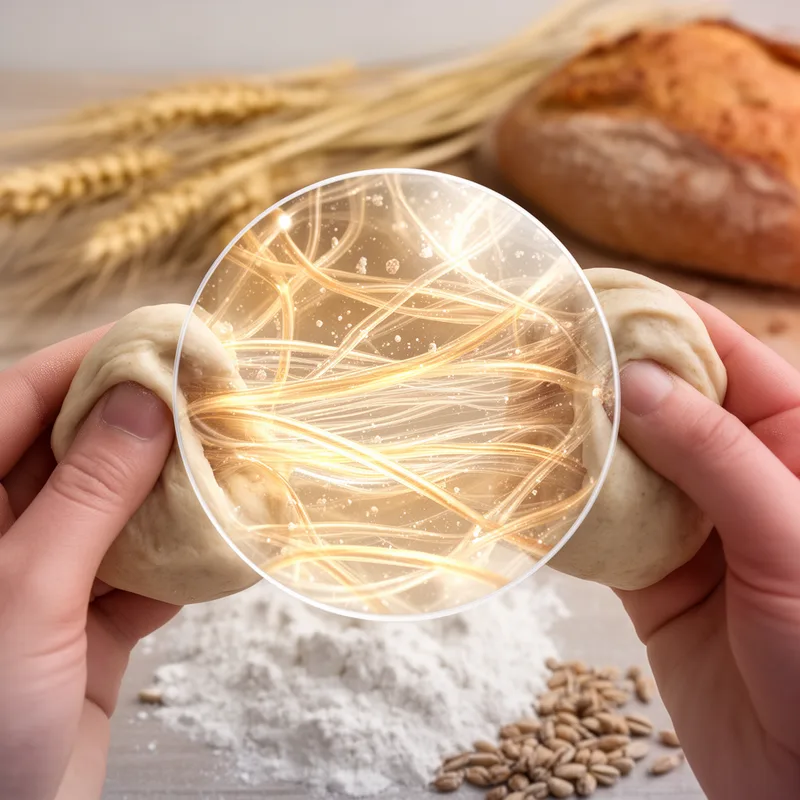
The proteins that form gluten, gliadin and glutenin, give dough its structure.
Surface Forms
Morphology
gliadin = gliad + in
The element 'gliad' is an obscure combining form (not a standalone English word) and while '-in' is a protein-forming suffix, this composition is not predictable for average learners from known English vocabulary.
Etymology
Gliadin comes from the Greek root glia meaning 'glue' plus the common protein ending -in, and it is closely linked to gluten. It is a protein in wheat, so you can think of it as the 'glue' that makes dough stretchy, which explains why it matters for people with celiac disease.