

to glaze over
 11
5.3
11
5.3

- phrasal verb
- /ɡleɪz ˈoʊvər/
- When you try to explain, their eyes glaze over.
- eyes glaze over
Loading YouTube…
Watch on YouTubeWhen we overuse a term like narcissism, people's eyes glaze over and they stop taking it seriously.
- When we overuse a term like narcissism, people's eyes glaze over and they stop taking it seriously.
- Your fog glazed over eyes can't see that far.
Examples
-
Since I am not a chemist, my eyes tend to glaze over at the details.
Blog text (9) -
Julie looks out the window with glazed-over eyes.
Fiction book (1998) -
You face the fact that his eyes have been glazed over for a long time.
Fiction book (1992) -
Instead, he looked out beyond the window and his eyes glazed over, as if he were trying to see into the past.
Fiction book (2000) -
That probably made your eyes glaze over as I started reading it, right?
-
See how long it takes for his eyes to glaze over.
-
If all this is beginning to make your eyes glaze over, please be patient.
Fiction book (2000) -
Deckie's eyes glazed over, and he began looking toward the house.
Fiction book (1999) -
After that, even the best, most attentive students' eyes glaze over, and they begin to fidget.
Blog text (25) -
When she started telling the long story, I could see his eyes glaze over with boredom.
Synonyms
 25
4.6
25
4.6
To become smooth and shiny in look, often because someone is tired or not paying attention
 20
3.7
20
3.7
To lose focus so that things look unclear


 1
7.2
1
7.2
To become smooth and shiny, like a clear window
 1
6.8
1
6.8
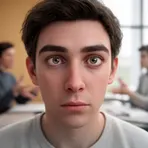
Eyes or face become dull and show no expression
 1
7.3
1
7.3
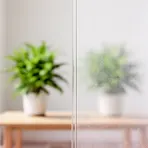
To become covered with a thin layer that makes eyes or glass look cloudy
How Dull

Surface Forms
Morphology
glaze + over
The meaning 'to become shiny, glassy, and unfocused' is directly derivable from 'glaze' (to become or make glassy) combined with the particle 'over' indicating a resultant or changed state; a learner who knows both words can predict this sense. This verb+particle composition follows common, cross-linguistically recurrent patterns (eyes becoming glassy), so the expression is immediately comprehensible rather than idiomatic.
Etymology
The verb glaze over comes from the image of eyes getting a shiny, glass-like layer, like pottery with a glaze on it. So when someone's eyes glaze over, they look bright but empty and 'unfocused' from tiredness or boredom.