

giant silkworm moth
- noun
- /ˈdʒaɪənt ˈsɪlkwɜrm mɔθ/
- Specialized
- Entomologists study the life cycles of the giant silkworm moth to better understand silk production.
Examples
-
Several species of giant silkworm moth inhabit the forests of South America and Asia.
-
The giant silkworm moth is prized for its beautiful, intricate wing patterns.
-
Look at that giant silkworm moth resting on the tree!
-
The giant silkworm moth is a marvel of nature!
-
Entomologists study the life cycles of the giant silkworm moth to better understand silk production.
-
Several species of giant silkworm moth inhabit the forests of South America and Asia.
-
The giant silkworm moth is prized for its beautiful, intricate wing patterns.
Synonyms

Large insect with bright wide wings whose caterpillars make silk cocoons and which often has eye-shaped wing marks
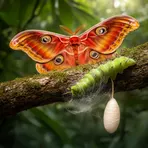
A large colorful moth whose caterpillars spin silk cocoons in tropical regions
How Big


Surface Forms
Morphology
The phrase is transparently compositional: 'giant' (very large) modifies 'silkworm moth' (a moth associated with silkworms or silk-producing species), so the overall meaning — a very large moth of the silkworm/Saturniidae type — is directly derivable from the parts. This adjective+noun+noun construction follows standard English patterns and is cross-linguistically common, so a B1 learner who knows the constituent words would readily understand it.
Etymology
Giant silkworm moth comes from a clear image: the caterpillars are 'silkworms' that spin 'silk', and the adult insect is very large, so the parts giant, silkworm, moth explain the name. So the phrase means a very large moth whose young make silk.