
geopolymer


 1
9.3
- noun
- /ˌdʒiːoʊˈpɒlɪmər/
- Specialized
- In addition, Table 3 displays the quantitative chemical compositional changes happening in the geopolymer matrix during acid attack.
- ash geopolymer
- geopolymer mortar
- geopolymer matrix
Loading YouTube…
Watch on YouTubeSo no, this theory that Doctor Barnhart proposes is not a geopolymer theory.
- So no, this theory that Doctor Barnhart proposes is not a geopolymer theory.
Examples
-
Hence, the research data presented herein will be extremely useful in predicting the performance of geopolymer produced with different low-calcium fly ashes.
Academic text (2017) -
The mesoporosity of fly-ash-based geopolymer increases with its degree of geopolymerization.
Academic text (2017) -
His research interests include concrete materials and engineering properties of geopolymer concretes.
Academic text (2017) -
The findings revealed that geopolymer cement possessed superior acid resistance compared to references.
Academic text (2018) -
Durability of geopolymer based on waste glass/CAC in mild acid solutions was studied.
Academic text (2018) -
In contrast, Collie geopolymer has a SiO2/Al2O3 ratio of 3.1 and gives the lowest compressive strengths.
Academic text (2017) -
Two out of the three geopolymer phases consist of aluminosilicate gel, but in different SiO2/Al2O3 ratios.
Academic text (2017) -
In the geopolymer reaction, precursor fly ash reacts with an alkaline activator and produces aluminosilicate gel.
Academic text (2017) -
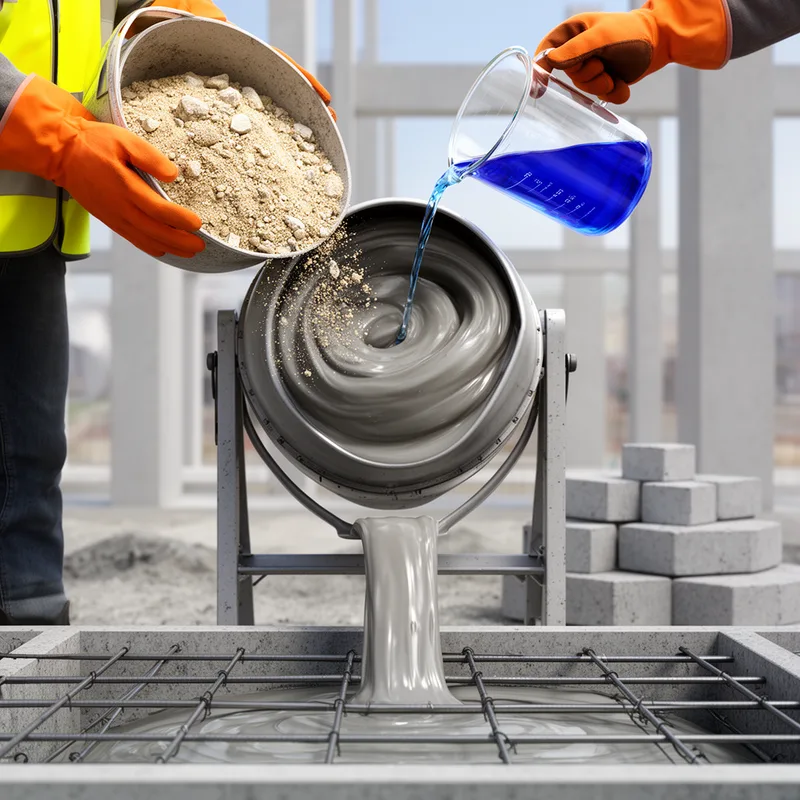
The construction workers used geopolymer as a sustainable alternative to traditional cement.
-
In recent years, geopolymer technology has gained popularity for its environmentally friendly properties.
Surface Forms
Morphology
Etymology
Geopolymer comes from geo- 'earth', as in geography, and polymer 'many parts', a word you meet in plastics. So a geopolymer is a material made by joining many earth minerals into a hard, cement-like substance, which is why it is used instead of ordinary cement.