

to give a whistle


 1
4.2
1
4.2
- phrasal verb
- /ɡɪv ə ˈwɪsəl/
- I gave a whistle and three hundred cries to you, and I found nothing there but a bleating lamb.
Examples
-
Give a whistle ♪ ♪
-
"He gave a whistle and then broke into song."
Fiction book (1992) -
Don't grumble, give a whistle.
Blog text (28) -
Artoo beeped affirmatively and gave a whistle that could only be a question.
Fiction book (1991) -
"Brenna gave a whistle to catch her father's attention, then mimed spooning up food."
Fiction book (2000) -
During the game, the coach gave a whistle to signal the end of practice.
-
She gave a whistle to call her dog back from the park.
-
To get attention, he gave a whistle that could be heard across the field.
Synonyms
 91
1.6
91
1.6
To make a high sound by blowing air through your lips or a small device
 7
3.3
7
3.3
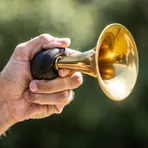
To make a short sharp sound with a horn or whistle
Antonyms

How Loud

Surface Forms
Morphology
The meaning 'to produce a whistling sound' is directly and transparently derived from combining 'give' (produce) with 'a whistle' (a whistling sound); the article 'a' is just a grammatical element. This compositional pattern (give + noun to mean produce a particular sound/action) is common in English and cross-linguistically, so a B1 learner who knows the constituents should readily infer the meaning.
Etymology
The phrase give a whistle comes from the simple action of making a short whistling sound. When someone gives a whistle, with their lips or a small whistle, they make a clear noise to get people's attention or to give a signal, so it means 'to attract attention' or 'to signal'.