
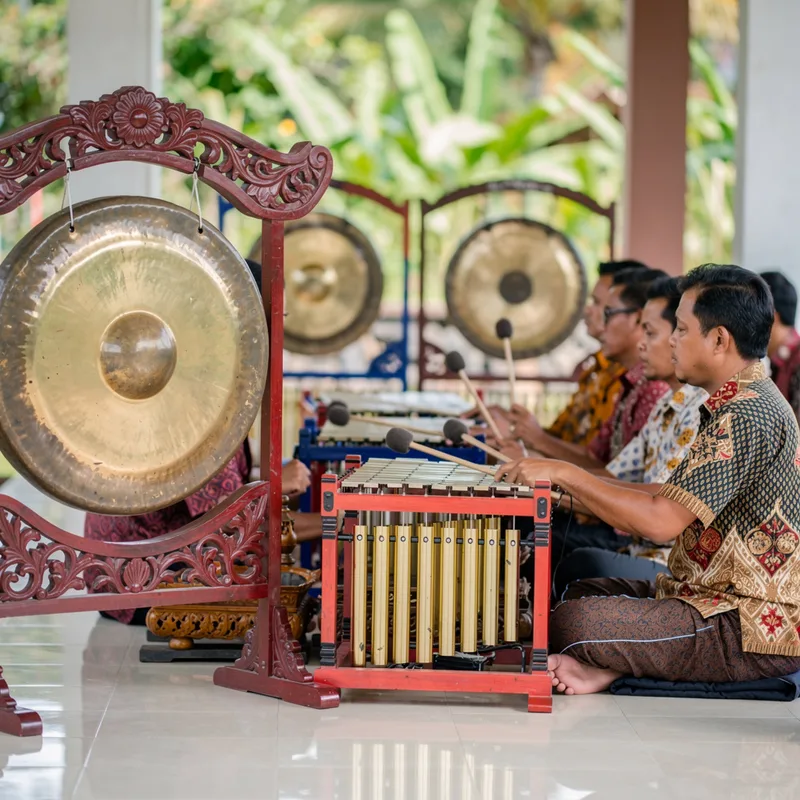
gamelan
 1
9.9

- noun
- /ˈɡæməˌlæn/
- A Gamelan group then entertained the assembly with Indonesian music.
- Balinese gamelan
- Javanese gamelan
- gamelan music
Examples
-
Areas of focus might include Indian ragas, the Javanese gamelan, Gypsy music, the Appalachian folk song tradition, spirituals, and the blues.
Academic text (1998) -
The many interrelated layers of melodies in the gamelan are derived from balungan, a skeleton or main melody.
Academic text (2015) -
As a closing exercise for the project, students provided a description of a gamelan and its purpose, which they wrote in their journals.
Academic text (1994) -
The registers of the gamelan instruments determine the density of the layers.
Academic text (2015) -
The university students watched as Morrison and her students demonstrated many aspects of the gamelan.
Academic text (2006) -
The first example was a commercial recording of gamelan music, the traditional pitched percussion ensemble native to Indonesia.
Academic text (2015) -
An old Dutch building is now a puppet museum featuring Javanese shadow plays and gamelan music.
Academic text (1993) -
One of the teachers, Dorothy Morrison, brought her eighth graders to the university to demonstrate the Balinese gamelan.
Academic text (2006) -
General music teachers can adapt instruments (e.g., modifying Orff instruments so they approximate the sound of a gamelan) or substitute instruments when performing music of various traditions.
Academic text (2006) -
The gamelan ensemble filled the air with beautiful sounds, as the musicians played their bronze instruments in harmony.
Surface Forms
Etymology
Gamelan comes from Javanese in Indonesia: the root gamel means 'to strike' and the ending -an makes it a group or thing, so a gamelan is literally a set of struck instruments like gongs and metallophones.