

galvanized iron
- noun
- /ˈɡælvəˌnaɪzd ˈaɪərn/
- Specialized
- One store building had a patchy galvanized iron cornice; the building beside it was crowned with battlements and pyramids of brick capped with blocks of red sandstone.
Examples
-
These cars were constructed with galvanized iron screen sides, which permitted free circulation of water.
Academic text (1999) -
With supplies delivered by Punch, the king erected a large council house with a galvanized iron roof and decorated the walls with bronze plaques (Home 1982:35).
Academic text (1997) -
It was one of the old types of colonial houses, built largely of weatherboard, with wide verandahs on every side and with an overhanging galvanized iron roof designed on the same principle as a sun helmet.
Fiction book (1994) -
The gardener recommended using a galvanized iron fence to protect the plants from rust and decay.
-
They installed a galvanized iron roof on the shed to ensure it would withstand the elements.
-
The contractor used galvanized iron pipes to prevent rusting in the plumbing system.
Synonyms
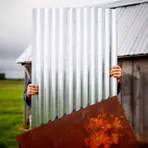
A strong metal sheet covered with zinc to stop rust
How Protected


Surface Forms
Morphology
The phrase is a straightforward adjectival composition of 'galvanize' (to coat with zinc) + 'iron' so its meaning 'iron coated with zinc to prevent rust' is directly derivable from the constituent words. This compositional pattern is literal and cross-linguistically common (e.g. galvanizado, galvaaniseer), so a B1 learner who knows the parts should understand it.
Etymology
Galvanized iron refers to iron that has been given a thin zinc 'coat' to stop it from 'rusting'. Imagine dipping a metal sheet into hot, liquid zinc so it gets a shiny skin like a raincoat; that's why the term means 'iron coated with zinc' today.