
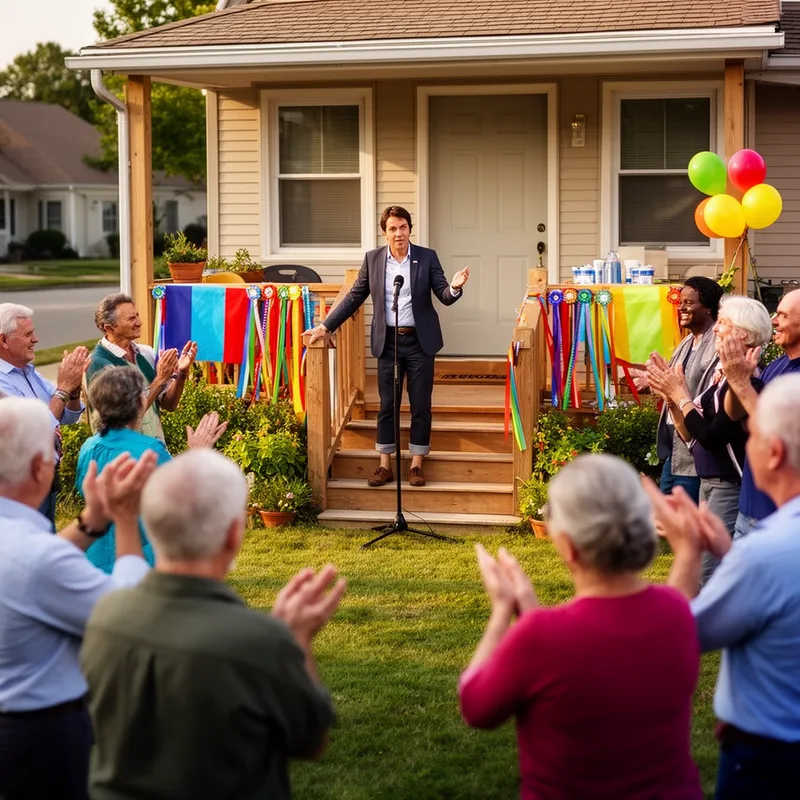
front-porch campaigning
- noun
- /frʌnt pɔrʧ ˈkæmpeɪnɪŋ/
- Literature
- Instead of traveling cross-country, the senator opted for front-porch campaigning to connect with voters locally.
Examples
-
William McKinley was famous for his front-porch campaigning during the 1896 election.
-
In the era before mass media, front-porch campaigning helped candidates appear dignified and approachable.
-
His front-porch campaigning was effective.
-
The candidate's front-porch campaigning attracted many local supporters.
-
In the era before mass media, front-porch campaigning helped candidates appear dignified and approachable.
-
Instead of traveling cross-country, the senator opted for front-porch campaigning to connect with voters locally.
-
William McKinley was famous for his front-porch campaigning during the 1896 election.
Synonyms

A campaign where a candidate meets voters at the candidate's home instead of traveling
How Mobile
 2
7.1
2
7.1


- Literature
Surface Forms
Morphology
front-porch + campaign
The phrase is directly compositional: 'front-porch' denotes the porch at the front of a house and 'campaigning' denotes political canvassing, so a learner who knows both constituents can infer campaigning that takes place from a candidate's front porch. This is a simple locative + activity construction (though somewhat regionally US), so the meaning is transparently derived from the parts.
Etymology
Front-porch campaigning comes from the picture of a candidate sitting on the front porch of their home while people came to visit and listen. So, it means 'a way of campaigning where the candidate stays at home and meets people on the porch instead of traveling around'.