

froglike
- adjective
- /ˈfrɔɡˌlaɪk/
- Nigel remembered feeling momentarily quite proud that though he was stumbling in a strange, hopping, froglike sort of way, his hands skipping along the ground, propelling him forward if not upright, he hadn't yet fallen flat on his face.
Examples
-
"Well, bravo!" grunted Olmstead, his froglike face beaming with sardonic appreciation.
Fiction book (1995) -
The figure squats froglike on a boulder, a collapsed pictorial depth making him appear smaller than human size.
Academic text (2003) -
Tarp asked the obvious question: "What's he gonna do if he doesn't get to be king?" At this moment, Mr. Mo proved that he had one other froglike characteristic.
Fiction book (2001) -
The artist's sculpture featured a froglike creature with bulging eyes and a wide mouth.
-
As she walked through the garden, she noticed a small, froglike animal perched on the lily pad.
-
He moved in a froglike manner, crouching low and leaping forward with ease.
Synonyms
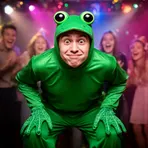

How Froglike

Surface Forms
Morphology
Etymology
Froglike comes from the animal frog and the ending -like, which means 'similar to'. Imagine something with big eyes, short legs, or a strong jump, so 'froglike' means 'looking or moving like a frog'.

