
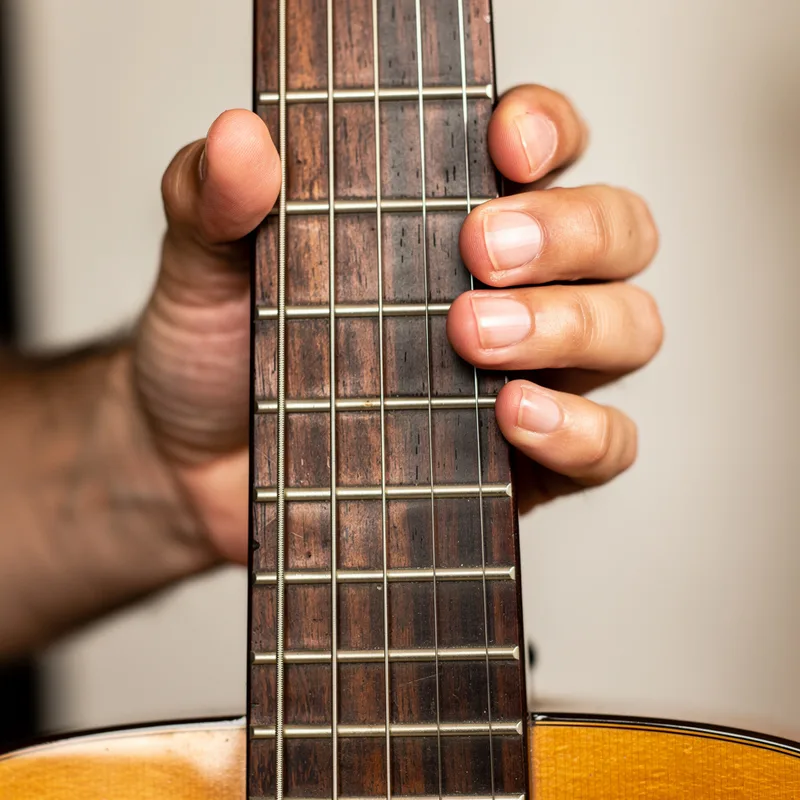
fretboard
 1
5.7
1
5.7

- noun
- /ˈfrɛtˌbɔrd/
- Specialized
 :
diapasón
:
diapasón
- Guitarists descend the fretboard to raise the pitch; a guitarist told to move two frets higher might play a lower tone.
- fretboard charts
Examples
-
The head and the fretboard are joined together by the nut, which can be a strip of medium-hard material.
Blog text (30) -
Fretboard charts usually depict single chords independent of time and rhythm.
Academic text (2010) -
Young students and many adults may have trouble stretching their fretboard hand across multiple frets.
Academic text (2010) -
Guitarists have developed additional forms of music notation to approach the fretboard.
Academic text (2010) -
Also, fretboard charts must be fairly large to be legible.
Academic text (2010) -
For the next hour or so, we watched in amazement as my uncle worked his way up and down the fretboard of that guitar effortlessly.
Fiction book (2002) -
Normally, the fretboard is flat on classical guitars and curved crosswise on electric and acoustic guitars.
Blog text (30) -
Guitarists who try to read staff notation must not only translate pitches and notes to locations on the fretboard; they must also match the intervals within the written work to ideal shapes across several strings.
Academic text (2010) -
Furthermore, adapted staff notation still emphasizes pitch over fretboard clarity; a guitarist must translate the given pitch and fingering to a precise location on the fretboard.
Academic text (2010) -
The musician placed his fingers on the fretboard to play the melody.
Synonyms
 1
6.4
1
6.4
A flat surface on a string instrument where you press strings to change notes
Surface Forms
Morphology
Etymology
The word fretboard comes from the parts fret and board. A fret is a 'small raised metal strip' on a string instrument and a board is a 'flat piece of wood', so a fretboard is the long flat part with frets where you press the strings to change the note.