
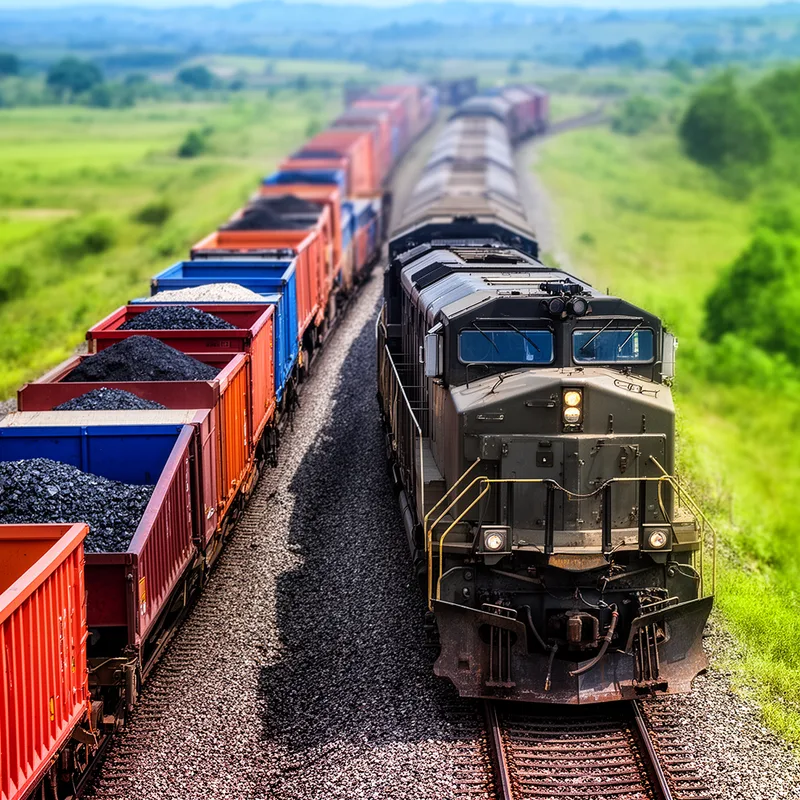
freight train
 20
2.8
20
2.8

- noun
- /freɪt treɪn/
- My grandfather and Mosom Edwin traveled from farm to farm by hopping freight trains.
Loading YouTube…
Watch on YouTubeI mean, I'm sure it is a freight train.
- I mean, I'm sure it is a freight train.
Examples
-
Well, at least he can listen to the whistle and rattle of freight trains coming and going.
Fiction book (2000) -
I'll have to leave Saratoga in a freight train.
-
Here comes the freight train.
-
Do you remember a freight train passing by just before the explosion?
-
Sophie arrives and says that a freight train is passing, a regular evening event.
Fiction book (1994) -
In the 1930s, more than 250,000 kids like Robert rode freight trains across America.
Academic text (2011) -
During the 1930s, most hoboes traveled from place to place by sneaking onto freight trains.
Academic text (2011) -
A postcard from Florida showed a freight train's flatcar loaded with an orange the size of a house.
Fiction book (1999) -
And as all of this was happening this long, slow freight train rolled by... its wheels making that clacking noise that'’s so reassuring.
-
The freight train delivered a large shipment of goods to the warehouse early in the morning.
Synonyms
 ∞
1.0
∞
1.0
A long set of connected cars that carries people on rails
 1
1.8
1
1.8
A long line of connected cars that runs on tracks and carries people or goods
 1
2.6
1
2.6
A train that carries letters and packages for the post

A long fast train that carries goods between factories and ports

A fast train that carries goods over long distances between factories and seaports and loads quickly
A very long freight train that carries many containers
Antonyms

How Big

Surface Forms
Morphology
The meaning 'a train carrying goods' is directly and compositionally derived from 'freight' (cargo) + 'train' (series of rail cars). This noun-noun compound follows a common and transparent pattern found across many languages, so a B1 learner who knows both constituents will readily understand the MWE.
Etymology
The compound noun freight train combines freight, meaning 'goods', and train, meaning a long line of connected rail cars. So it means 'a train for carrying goods'.