
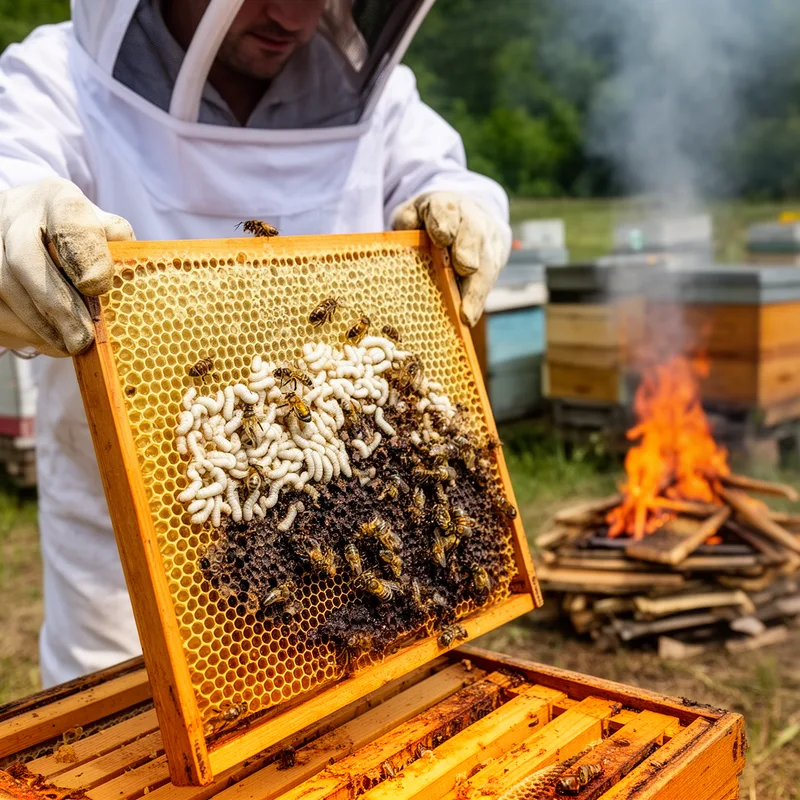
foulbrood
- noun
- /ˈfaʊlˌbrud/
- Specialized
- Consider what happens when closely related honeybees, or lines, are selected for resistance to foulbrood, a bacterial disease of honeybee larvae.
- foulbrood disease
Examples
-
Previously unknown in Nepal, the disease, called European foulbrood, is usually considered a "stress disease" of honey bees, manifesting itself only in colonies that are already under some kind of stress.
Academic text (1990) -
PHOTO (COLOR): The bacterium Paenibacillus larvae causes American foulbrood disease.
Academic text (2005) -
" But we're not sure whether a bee that produces more of this peptide is indeed foulbrood resistant. "
Academic text (2005) -
"We know these bees are responding to foulbrood by producing abaecin," Evans says.
Academic text (2005) -
Along with insect pests, parasites, and other pathogens, foulbrood outbreaks in U.S. hives cause $5 million annually in crop-pollination losses.
Academic text (2005) -
The foulbrood disease can devastate entire colonies of honeybees.
-
The beekeeper noticed the signs of foulbrood affecting the larvae in his hives.
-
To prevent foulbrood, beekeepers must regularly inspect their colonies for symptoms.
Surface Forms
Morphology
Etymology
Foulbrood combines foul ('bad' or 'rotten') and brood ('young' or 'offspring'), the same brood you see in 'a brood of chicks'. So it literally means 'rotten young', which helps you remember it is a disease that kills bee larvae and can destroy whole hives.

