

forelimb
 4
3.9
4
3.9

- noun
- /ˈfɔrˌlɪm/
- Specialized
- The sloth uses its long forelimb to reach for leaves high up in the trees.
Examples
-
Its powerful forelimbs and dexterous, three-clawed "hands" enabled it to reach even higher to pull branches to its mouth.
Academic text (2009) -
During rectilinear, fast swimming, the forelimbs (flippers) are not involved in propulsion; they merely act as steering devices (Fish and Hui 1991).
Academic text (2001) -
As Grant watched, a single forelimb reached up very slowly to part the ferns beside the animal's face.
Fiction book (1990) -
Seal locomotion on land, especially at slower speeds, is typically led by the head and forelimbs, rather than the center of mass.
Academic text (2018) -
Note the long legs and relatively short forelimbs, atypical for most pterosaurs.
Blog text (18) -
The spade-like forelimbs are enlarged and very powerful, ideally suited for digging.
-
Crucially, though, the forelimbs of Tiktaalik combine traits of fishes.
Academic text (2006) -
An analogous appendage, which evolved independently (and with five toes, not seven), is the forelimb of the modern river dolphin.
Academic text (2006) -
The insets show the creatures' right forelimbs (except for Ichthyostega, which is a right hind limb); the scale bars each represent one inch.
Academic text (2006) -
As in modern cetaceans, basilosaurids and dorudontids have a streamlined form, short neck, forelimbs shaped like flippers, and strongly reduced hind limbs.
Academic text (2001)
Synonyms
 4
1.8
4
1.8
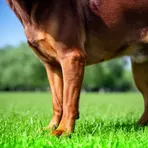
A front leg of a four-legged animal like a dog or horse
Surface Forms
Morphology
Etymology
Forelimb is made of fore- meaning 'front', seen in forehead, and limb meaning 'arm or leg'. So a forelimb is the front arm, wing, or flipper of an animal.