

food grain


 1
2.3
1
2.3
- noun
- /fuːd ɡreɪn/
- Farmers in the region rely on food grains like rice and wheat to sustain their livelihoods.
- food grain production
- food grain, wheat
Examples
-
Devoting land to growing biofuels "exacerbates the problem of malnourishment worldwide" by turning much-needed food grain into biofuel.
Academic text (2010) -
The rural poor typically ate less food grain, cultivated much less irrigated land, and possessed houses and financial assets of substantially lower value than the non-poor.
Academic text (1995) -
Food grains have become available.
Academic text (2000) -
In Asia, corn is mostly a minor food grain even now, but it has established itself in many cultures.
Academic text (1992) -
World food grain production will grow on average by 1.5 percent per year, a rate high enough to increase the global per capita availability of food and to reduce real prices.
Academic text (1996) -
The main items were oilseeds, wheat, food grains, and cotton goods.
Academic text (2005) -
In spite of Egypt using most of its share of the Nile water for irrigation, at present it imports more than half of its food grains.
Academic text (2008) -
Consumer goods imports were banned completely, except those that governmental agencies imported or judged essential for everyday existence, such as edible oils, drugs and medicine, kerosene, and food grains.
Academic text (1994) -
They are equally involved in pre-harvest agricultural activities such as soil preparation, planting, weeding, and harvesting, and post-harvest activities such as the storage of food grains.
Academic text (2014) -
The transplanting of rice or onion and harvesting of food grains, groundnut (peanut), or onion on a specified plot are the most common tasks that are contracted out to groups (gumpu).
Academic text (2004)
Synonyms
 203
1.0
203
1.0
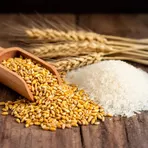
An edible seed from plants like wheat or rice used as food
Surface Forms
Morphology
The meaning 'a grain used as food' is directly and literally derived from combining 'food' (substance consumed) with 'grain' (edible seed of cereals). This compositional noun phrase follows a transparent, cross-linguistic pattern, so a B1 learner who knows both constituents will readily infer the MWE's meaning.
Etymology
Food grain names the small grain or seed from plants like wheat or rice that people eat. Think of tiny seeds in a sack—this simple image explains why it means 'a grain used as food' today.