
fluoroscopy


 1
7.2
- noun
- /flʊəˈrɒskəpi/
- Specialized
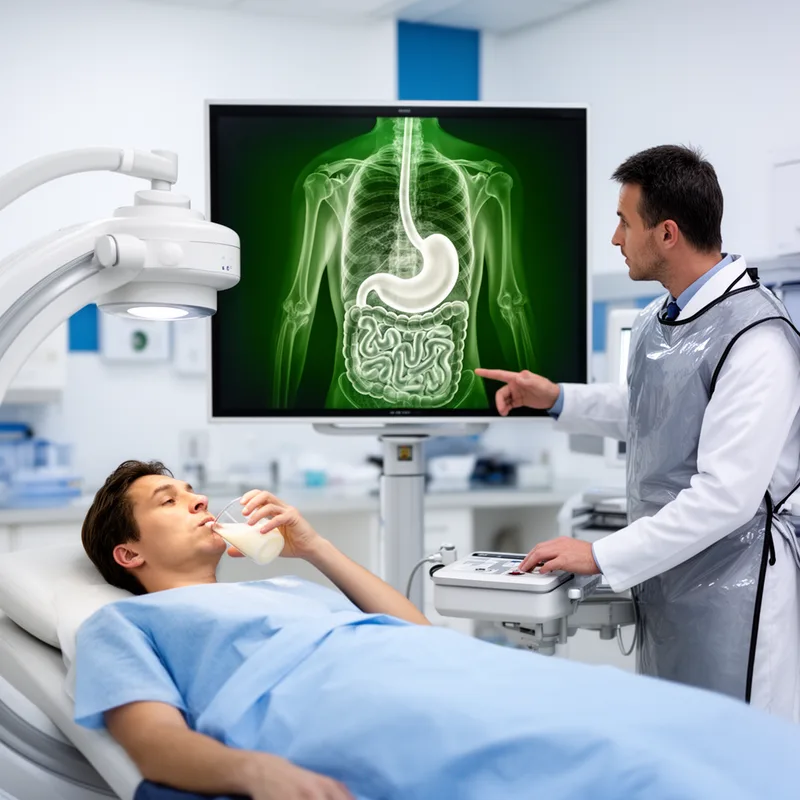
- Fluoroscopy is a variant of this procedure in which a fluorescent screen and an electronic image intensifier are used to form a continuous "moving picture."
- commonly used fluoroscopy
Examples
-
A fluoroscopy system is fundamentally a video X-ray machine, capable of taking continuous pictures of an object using only a small X-ray dose (box 1).
Academic text (2004) -
Two of the most common instrument-based examinations that guide the dietary and behavioral management of patients with dysphagia are fluoroscopy and endoscopy.
Academic text (2001) -
Images are taken using both fluoroscopy and radiography and can be coupled to a CT examination as indicated below.
Academic text (2006) -
The type of fluoroscopy used in that study was a modified barium swallow (MBS) procedure.
Academic text (2001) -
The percutaneous discectomy is done under fluoroscopy with a cannula inserted through the flank area.
Academic text (2005) -
Instead of acquiring the image on a film, fluoroscopy relies on X-ray detector systems capable of producing real-time images, which are then displayed on a monitor.
Academic text (2004) -
Fluoroscopy is commonly used in angiography for studying blood vessels in the brain or guiding catheters (Lipsitz et al. 2003).
Academic text (2004) -
A recent study compared pneumonia outcomes among non-cancer patients with dysphagia who were diagnosed and managed on the basis of the results of randomly assigned fluoroscopy or endoscopy.
Academic text (2001) -
The distal esophagus was dilated with a balloon to 18 mm; this caused some superficial mucosal tearing, but no evidence of perforation was seen on subsequent fluoroscopy.
Academic text (2009) -
The doctor used fluoroscopy to observe the patient's digestive tract in real-time during the examination.
Synonyms

A medical check that uses X-rays to look inside the body for problems
Surface Forms
Morphology
fluoroscopy = fluoro + scop + y
This is a specialized medical term built from classical combining forms for fluorescence/fluorine and viewing, but an average B1 learner would not infer the meaning from the parts.
Etymology
Fluoroscopy breaks into two parts: fluoro-, from 'fluorescent' meaning 'glowing' or 'light', and -scopy, meaning 'to look', as in scope or microscope. So, fluoroscopy is like 'looking with light', which explains why it lets doctors watch moving images inside the body in real time.