
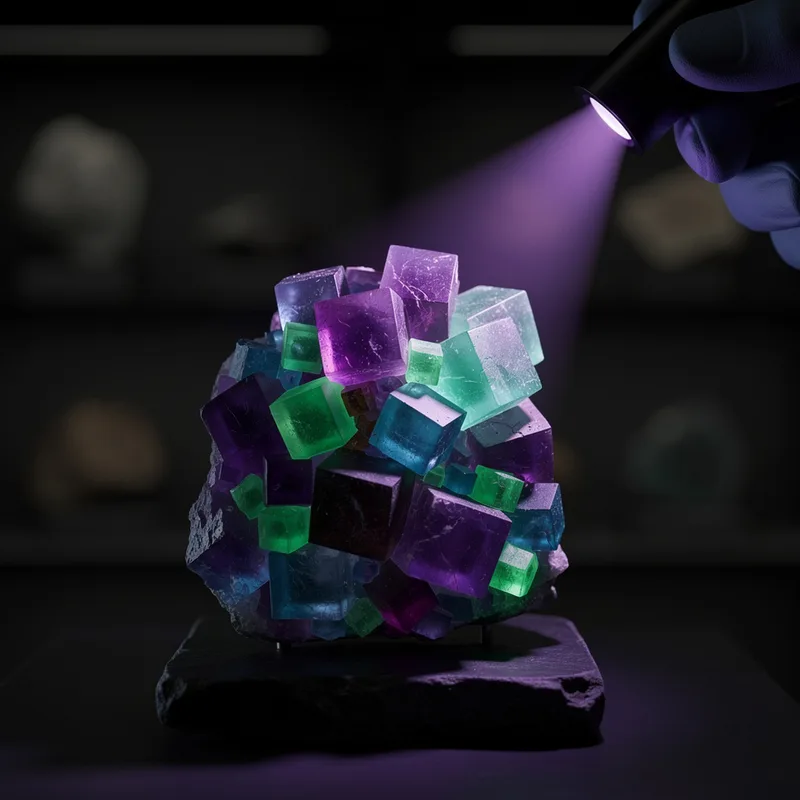
fluorite
 1
8.3
1
8.3

- noun
- /ˈflʊəraɪt/
- Specialized
- Also, his transistor radio and his pocket piece of purple fluorite.
- fluorite glass
- made of fluorite
Loading YouTube…
Watch on YouTubeThe the Inca made tons of jewelry out of fluorite.
- The the Inca made tons of jewelry out of fluorite.
Examples
-
Mobile crushing station operates on fluorite ore.
Blog text (17) -
It's the very best manufacturing line of mining fluorite ore.
Blog text (17) -
That's why you can shine UV light on fluorite but then see it glow in blue.
-
The mobile crushing station is definitely the effective production line to mine fluorite ore with high effectiveness and precision.
Blog text (17) -
These stones were known as snake eyes stones; later, the men and women understood that the snake eyes stones had been fluorite ores.
Blog text (17) -
It is very rare to find fluorine, though, and isolating it from another mineral called fluorite is also very difficult.
Blog text (4) -
Some of the good multi-coatings (like Super-Spectra Coating) used on high-quality lenses and even lens materials like fluorite and low-dispersion glass used today have an effect that lightens a circle in the center of the image, resulting in a "hot spot."
Academic text (2008) -
The range is as follows: talc 1; gypsum 2; calcite 3; fluorite 4; apatite 5; orthoclase 6; quartz 7; topaz 8; corundum 9; and diamond 10.
Academic text (1993) -
Many collectors are fascinated by the colorful cubic crystals of fluorite found in nature.
-
Under ultraviolet light, fluorite can exhibit a stunning fluorescence that attracts mineral enthusiasts.
Synonyms
 1
9.9
1
9.9
A soft mineral that glows blue or violet under ultraviolet light and supplies fluorine for industry
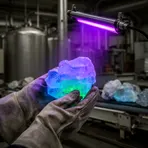
A mineral that often glows under ultraviolet light and is used in industry
How Hard


Surface Forms
Morphology
fluorite = fluoride (opaque) = fluor + ite
The combining form 'fluor-' is not a standalone English word for most learners and '-ite' is a technical mineral suffix, so the meaning is not directly derivable by average learners.
Etymology
The word fluorite comes from the Latin root fluor-, from fluere 'to flow', because people used it to help metal flow when it was melted. You can see the same root in fluid ('flow') and fluorescent ('glow'), so the name links its old use in metal work and the way some crystals 'glow' under ultraviolet light.