
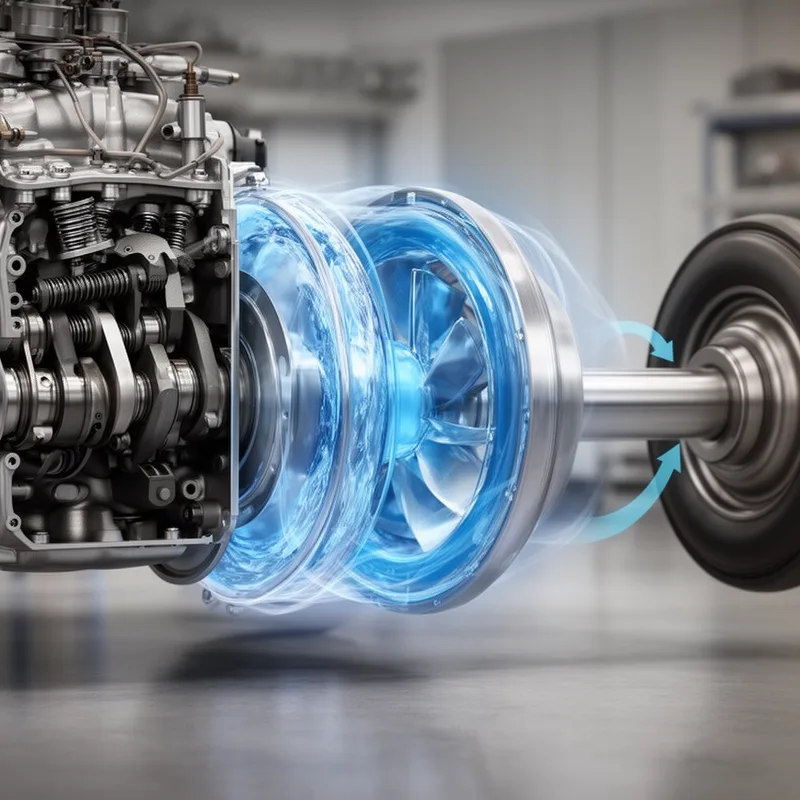
fluid drive
- noun
- /ˈfluːɪd draɪv/
- Archaic
- The car's fluid drive allows for a smoother ride by seamlessly transmitting power from the engine to the wheels.
Examples
-
Like all cars at the time, it had a manual transmission, but it was of an advanced kind called fluid drive, I think, and it didn't require so much clutch work.
Academic text (1990) -
A contemporary reader will see this as a kind of fluid drive used in automatic automobile transmissions.
Academic text (1997) -
Powered by ocean and/or large river currents, the turbine has an internal fluid drive that can provide multi-megawatts of affordable, pollution-free power.
Blog text (5) -
Interestingly, when a smooth rotary motion was needed, a sort of crude fluid drive was invented by having the reciprocating pumps deliver water to a reservoir, which then served a water wheel.
Academic text (2003) -
Many modern automatic vehicles are equipped with a fluid drive that enhances performance and efficiency.
-
In this model, the fluid drive is essential for ensuring that the engine operates smoothly with minimal gear shifting.
Synonyms

A device that uses fluid to send engine power to the transmission smoothly
A system that uses liquid under pressure to move parts of a machine

A system that uses liquid under pressure to send power in machines like tractors
Surface Forms
Morphology
The noun phrase denotes a type of drive that uses a fluid to transmit power, which is directly compositional from 'fluid' (a substance that flows) + 'drive' (a device that transmits mechanical power). This straightforward noun-noun compounding follows common cross-linguistic patterns, so a B1 learner who knows both constituents would likely infer the meaning.
Etymology
Fluid drive comes from the literal idea of placing a fluid (a liquid) between the engine and the wheels so power passes through the liquid to move the drive. Because the liquid lets power flow smoothly instead of in hard hits, the name now means a device that gives a 'smoother ride' and causes less wear.

