
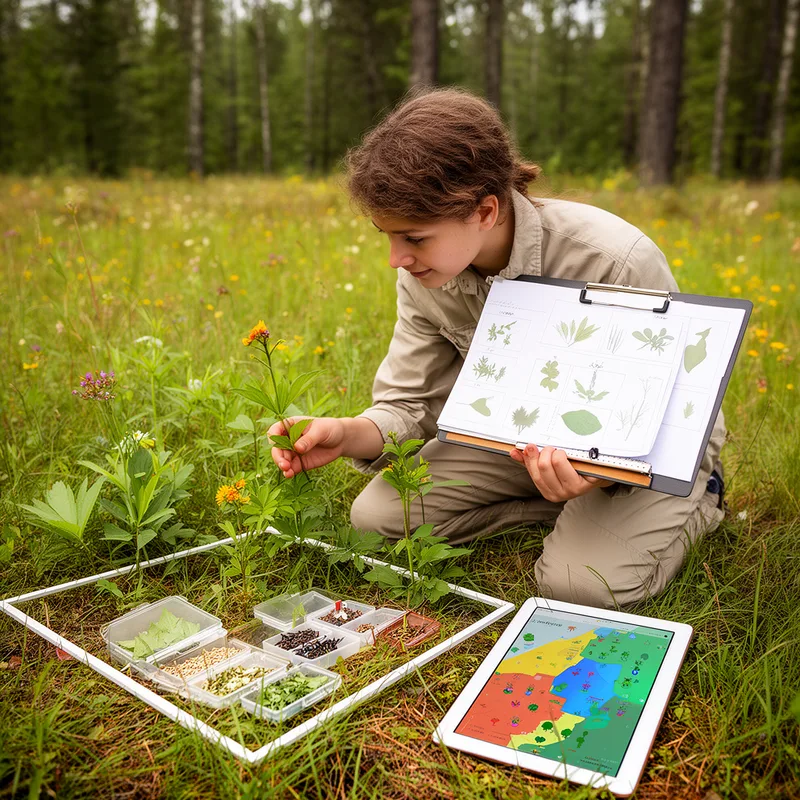
floristics
- noun
- /fləˈrɪstɪks/
- Specialized
 :
florística
:
florística
- A thorough understanding of the floristics in this region is essential for conservation efforts and habitat restoration.
Examples
-
Additionally, because the colors on Kuchler's floristic-physiognomic map correspond more to physiognomy than to floristics, this map presents little information of value to the task at hand.
Academic text (1991) -
Investigators who concentrate on garden plants as biological entities recognized early on that these assemblages had complex structures and could be analyzed for their floristics.
Academic text (2004) -
Kuchler's notes supply ample data to produce maps based on physiognomy, floristics, or any combination of the two.
Academic text (1991) -
Initial work focused on relationships among soil, floristics, forest structure, stand dynamics, and volume change (Ashton 1978, Ashton and Brunig 1975, Ashton and Hall in press).
Academic text (1992) -
The research team published a comprehensive study on the floristics of the local wetlands, detailing the various plant species found there.
-
As part of the survey, the botanists collected data on the floristics of the forest to understand its biodiversity.
Surface Forms
Morphology
floristics = floristic (semi-transparent) = flor + istic + s
The relation between 'floristic' (relating to flora) and 'floristics' (the field) is regular, but the combining form 'flor-' and the specialised suffix sequence ('-istic' + '-s') may be unfamiliar to learners.
Etymology
Floristics comes from flora, meaning 'plants or flowers', and the ending -istics, which means 'the study of', as in linguistics. So, floristics is the study and listing of the plants found in a place.

