
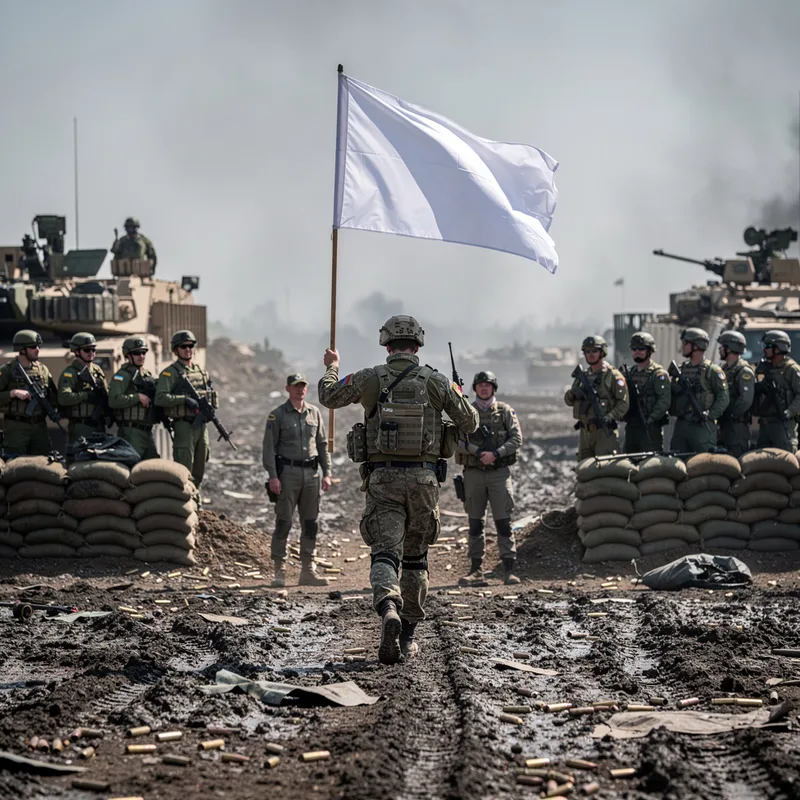
flag of truce
 3
4.9
3
4.9

- noun
- /flæɡ əv truːs/
- Formal
- What say we run up a flag of truce, I scurry over to the Interceptor, and I negotiate the return of your medallion?
- a white flag of truce
Examples
-
And I thank you deeply for observing my flag of truce.
-
Father, do you know what he will do if I enter his land under a flag of truce?
-
Those people are under the protection of a flag of truce.
-
But to our surprise, we soon saw a flag of truce flying on the ship.
Fiction book (2000) -
Look, when the time comes, and he's close... ...just send a messenger over under a flag of truce and go on over.
-
As he sits on his horse and looks at the place, surmounted by a white flag of truce, it gives him a chill.
Fiction book (1995) -
Sir, they're waving a flag of truce!
-
The soldiers raised a flag of truce to signal their desire to negotiate a ceasefire.
-
During the negotiations, one party displayed a flag of truce to indicate they wanted peace.
-
When the flag of truce was seen, both sides stopped fighting and came together to talk.
Synonyms
 19
2.7
19
2.7
A plain white cloth that people raise to show surrender or ask for a truce

A light brown cloth signal showing a temporary stop or truce
Surface Forms
Morphology
The meaning is directly and compositionally derived from 'flag' (a piece of cloth flown as an emblem) + 'of' (linking) + 'truce' (a pause in conflict): a flag indicating a truce or request for a ceasefire. This structure and logic are cross-linguistically common (e.g., Spanish 'bandera de tregua', French 'drapeau de trêve'), so a B1 learner who knows the parts will readily infer the MWE meaning.
Etymology
The phrase flag of truce comes from the simple image of a white flag raised to ask for a truce. When soldiers showed this white cloth, both sides would stop fighting and meet safely, so today it means 'a request for a ceasefire or negotiation'.