

to fizzle out
 8
5.3
8
5.3

- phrasal verb
- /ˈfɪzəl aʊt/
- Informal
- Her enthusiasm for the project seemed to fizzle out after the initial excitement wore off.
- it just fizzled out
- it soon fizzled out
- it fizzled out quickly
Loading YouTube…
Watch on YouTubeSo why do why do child prodigies fizzle out?
- So why do why do child prodigies fizzle out?
- In other words, some connection might happen real quick, but also might fizzle out real quick.
- He was devoured by Trump on the debate stage and he kind of fizzled out.
- So you see many relationships that start off hot and heavy and they fizzle out big time.
- And This is why you see all sorts of people move up, move up, move up, fizzle out, fail.
- Ultimately, the script fizzled out and he fizzled out in such a drastic and dramatic fashion.
- NA Group that focuses on things like COVID says earlier strains of the coronavirus fizzled out.
- So it could end up being the most incredible thing that we've seen in the sky for years, or it could end up just fizzling out.
- And oh, it really just, they're, yeah, it really kind of fizzles out because of sort of a combination of all those things.
- I've let friendships that have that fizzle out.
- Hot and heavy relationships falling too fast and why this fizzles out as fast as it starts typically.
Examples
-
If this thing is of men, it will fizzle out, like so many movements have before it.
Blog text (16) -
I was under the impression that research on NLP fizzled out years ago due to disappointing results.
Blog text (21) -
In other words, some connection might happen real quick, but also might fizzle out real quick.
-
Which is one pretty good reason the collection fizzled out.
Fiction book (2000) -
Many patterns just fizzle out, but a few keep growing forever.
-
Most online businesses fizzle out -- let's do something about that.
Blog text (24) -
They failed, they fizzled out, they were rejected.
-
That's just going to fizzle out very, very slowly and then just die a death.
-
Maintain long-term investments instead of getting caught up in flash-in-the-pan options that may fizzle out very quickly.
Blog text (1) -
Ultimately, the demands of the Pentecostals that the sculptures be removed were not met, and the controversy fizzled out.
Academic text (2009)
Synonyms
 531
1.2
531
1.2
To slowly become less visible, bright, or loud
 72
5.1
72
5.1
To become smaller or less in number over time
 69
3.0
69
3.0
To become weaker and then disappear over time
 49
2.6
49
2.6
Become less in number, amount, or quality
 48
4.9
48
4.9
To lose confidence, strength, or determination and become less able to continue
 48
6.4
48
6.4
To become less in size, amount, or strength
 46
2.7
46
2.7
To become less strong or loud over time
 27
5.6
27
5.6
To end in a weak or disappointing way after a promising start
 19
4.3
19
4.3
To become less in amount or quality
 9
5.6
9
5.6
To slowly become weaker and then stop
 9
4.5
9
4.5
To become smaller or weaker over time until it stops
 8
4.2
8
4.2
To become quieter and then stop
 6
4.8
6
4.8
To lose energy or enthusiasm and stop working well
 3
3.9
3
3.9
To become less strong or busy

To flow back or become less strong slowly
Antonyms


How Strong
350
4.1

- Informal
8
5.3
9
5.6
69
3.0
8
4.2
Surface Forms
Morphology
fizzle + out
The verb 'fizzle' already encodes the idea of losing momentum or ending weakly, and the particle 'out' contributes a sense of completion/cessation, so the overall meaning is largely derivable from the parts. However, because this is a phrasal-verb pattern where the particle adds nuance and 'fizzle' is a relatively low-frequency verb, the exact nuance may not be fully predictable to a B1 learner without some exposure.
Etymology
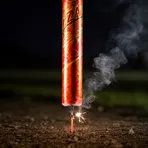
Fizzle out comes from the image of a weak firework or match that makes a soft hissing called a fizz and then dies without a bang. That's why it means 'to slowly lose energy and end in a weak or disappointing way'.