

fixed-point notation
- noun
- Specialized
- When working with currency, fixed-point notation helps to avoid rounding errors common with floating-point calculations.
Examples
-
Many embedded systems use fixed-point notation because it requires less computational power than floating-point notation.
-
The programmer chose fixed-point notation to ensure precise and consistent handling of large data sets.
-
The fixed-point notation simplifies calculations in many applications.
-
Can you explain fixed-point notation to me?
-
Many embedded systems use fixed-point notation because it requires less computational power than floating-point notation.
-
When working with currency, fixed-point notation helps to avoid rounding errors common with floating-point calculations.
-
The programmer chose fixed-point notation to ensure precise and consistent handling of large data sets.
Synonyms
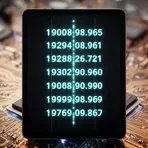
A way to show numbers where the decimal point stays in the same place
Antonyms

- Specialized
A way to write very large or very small numbers using an exponent so the decimal point can move
Surface Forms
Morphology
fixed-point + notation
The phrase is compositionally transparent: a B1 learner who knows 'fixed', 'point', and 'notation' can infer this refers to a way of writing numbers where the decimal/radix point is held in a fixed position. Although the concept is technical, the literal combination 'fixed-point' + 'notation' directly signals the fixed position of the point and has close equivalents in other languages, making the meaning derivable from the parts.
Etymology
The term fixed-point notation comes from the image of a point that is fixed in one place, like a dot on a ruler that does not move when you line up numbers. That's why it means a way of writing numbers where the 'decimal point' stays in the same place for every number, making simple calculations easier and more reliable.

